INSIDER SCOOPMost international travel itineraries treat Xi’an as a rushed 24-hour checklist: sprint out to the Terracotta Army, walk thirty paces into the tourist chaos of Muslim Street, glance at the Bell Tower, and board the evening high-speed train to Chengdu. Doing so misses the living soul of ancient Chang’an. Tucked behind the tour-bus routes are quiet Tibetan Buddhist courtyards, secluded Qin dynasty ginkgo groves, residential blocks serving the city’s crispest roujiamo, and a nocturnal Tang dynasty spectacle that completely transforms the southern district after sunset.
Key Takeaways (TL;DR)
- The Datang Everbright City Mindset: Treat the 2.1-kilometer pedestrian avenue as a joyful, free-admission nocturnal carnival. Arrive around 18:30 as the lanterns illuminate, rent a full Tang Dynasty hanfu robe with professional hair and makeup for ¥80–¥300, and watch the open-air shows. Every street performance is free; ignore anyone attempting to sell “reserved seats.”
- Payment Ease: All 299 licensed merchants across the Datang Everbright City district accept international Visa and Mastercard directly. For back-alley noodle spots and morning markets, link a foreign card to Alipay or WeChat Pay.
- The Food Golden Rule: Bypass the souvenir trinkets on the main spine of Huimin Street (Muslim Street). The genuine culinary magic hides in residential compounds like Zhonglou Community (钟楼小区), breakfast lanes like Xuanfengqiao (玄风桥), and narrow residential alleys where local grill masters serve ¥1.2 charcoal skewers.
- The Crowd-Free Sanctuaries: When the major monuments overwhelm, seek out Shaanxi Archaeology Museum (China’s sole archaeology-specific museum, housing 90% debut artifacts), the peaceful red walls of Guangren Temple, and the quiet bronze avenues of Qin Er Shi Mausoleum.
- Iconic Experiences Done Right: Rent a single-speed cruiser on the Xi’an Ancient City Wall at 17:00 to complete the 14-kilometer perimeter during golden hour, and visit Qizai (七仔), the world’s only captive brown giant panda, at Qinling Four Treasures Science Park before his morning nap at 09:30.
1. Midnight in Chang’an: The Datang Everbright City Playbook
When dusk settles over the Yanta District, Xi’an undergoes an astonishing shift. Modern office towers fade into shadow, and a 2.1-kilometer pedestrian avenue known as Datang Everbright City (大唐不夜城) bursts into a sea of crimson lanterns, floating poetry banners, and golden eaves.
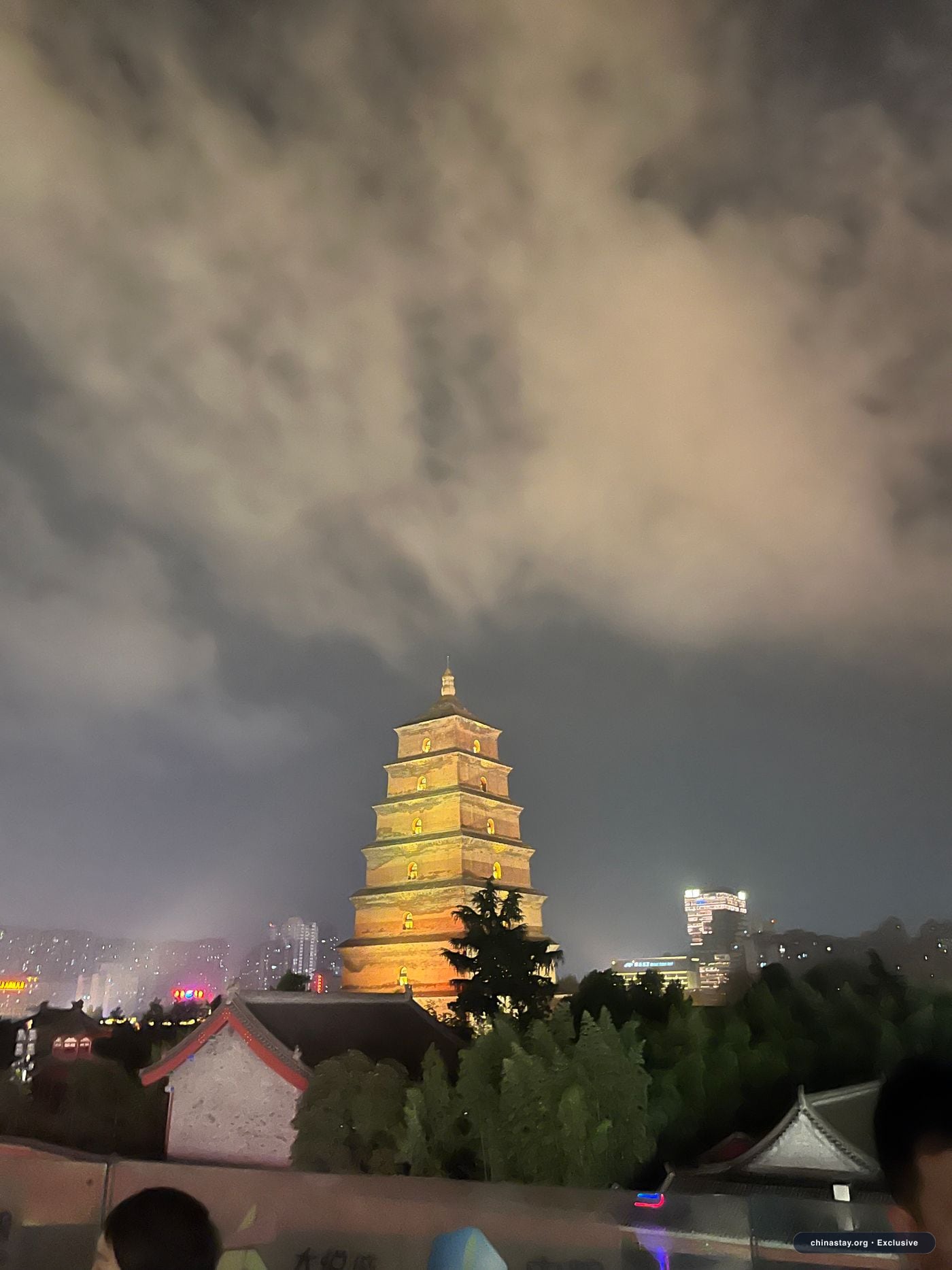 The ancient Big Wild Goose Pagoda (大雁塔) illuminated against the night sky, framed from the rooftop viewing deck of Joy City.
The avenue stretches south from the foot of the Big Wild Goose Pagoda (大雁塔)—the brick stupa erected in 652 CE by Buddhist monk Xuanzang to house the Sanskrit sutras he carried back from India, an expedition that inspired the classic epic Journey to the West. While daytime travelers come to admire the masonry, evening transforms the entire corridor into an open-air cultural festival celebrating the Tang Dynasty’s golden age. Admission is completely free, requiring no reservation or ticket.
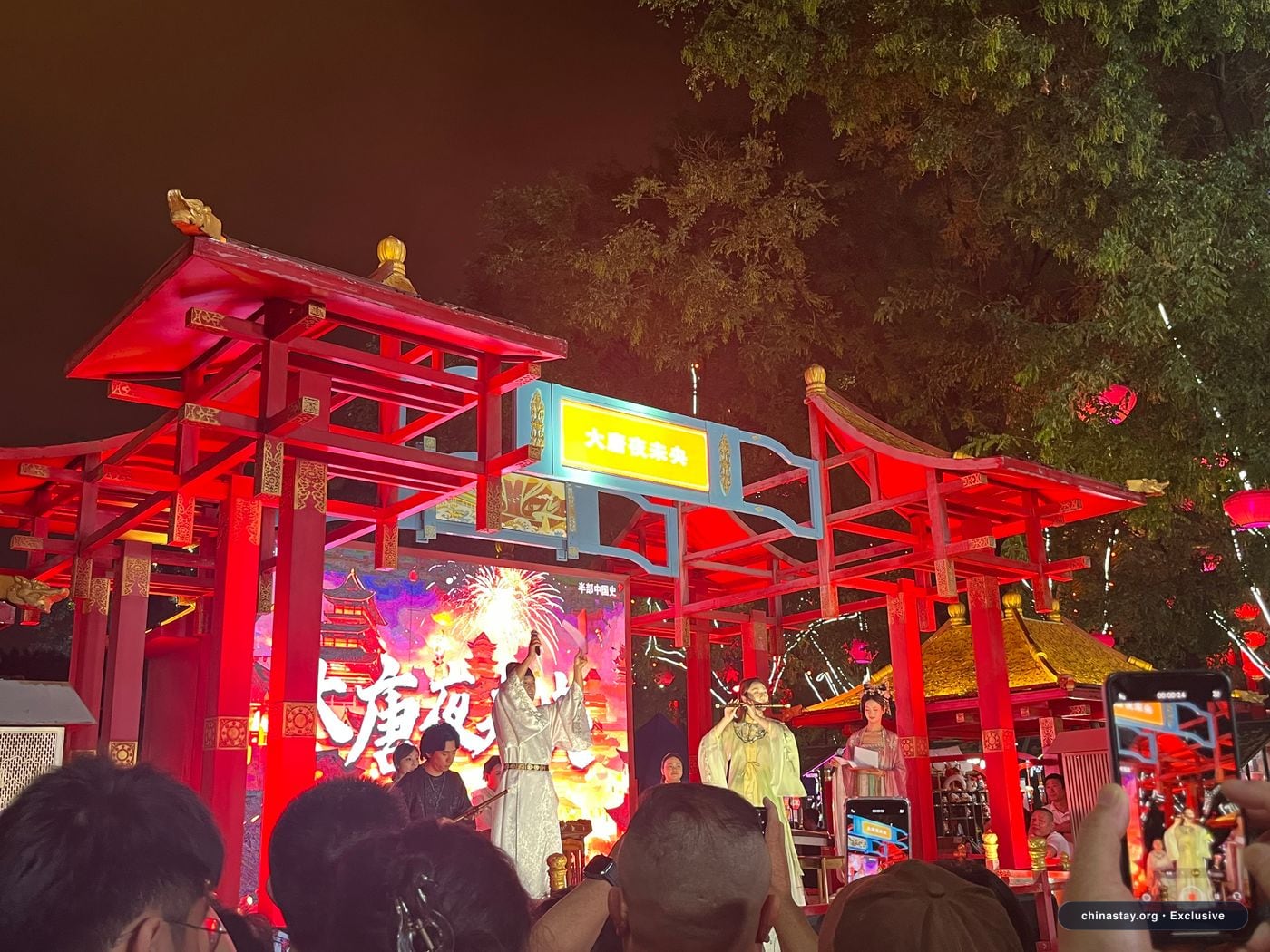 Live theatrical performance at the “Datang Ye Wei Yang” pavilion along the pedestrian promenade.
Between 19:00 and 22:30, the promenade fills with rotating theatrical spectacles. At Kaiyuan Square, enormous crowds gather to catch the famous Wobbling Lady (不倒翁小姐姐), where performers in flowing dynastic gowns balance atop weighted spheres, swaying gracefully through the air and reaching out their silk sleeves to touch visitors’ fingertips for an auspicious blessing.
Further down the avenue, two sharp-witted actors dressed as Tang court officials Fang Xuanling and Du Ruhui host Sheng Tang Mi He (盛唐密盒). They invite audience members onto the stage for rapid-fire quizzes covering classical poetry, history, and geography; even if your Chinese is basic, the contestants’ flustered reactions and the crowd’s roars of laughter are instantly contagious. At 21:00, the grand open-air production Return to Chang’an (再回长安) unfolds with sweeping choreography and orchestral music, while wandering actors portraying poet Li Bai roam beneath illuminated calligraphy banners, reciting verses to passersby. Every single street performance is free. Anyone offering to sell “front-row VIP passes” or “reserved seats” is running a street scam.
Near the north square, you can catch the massive musical fountain shows at 19:00 and 21:00, or walk through poetry lane where glowing Tang verses hang overhead and interactive floor tiles bloom with digital petals under your footsteps.
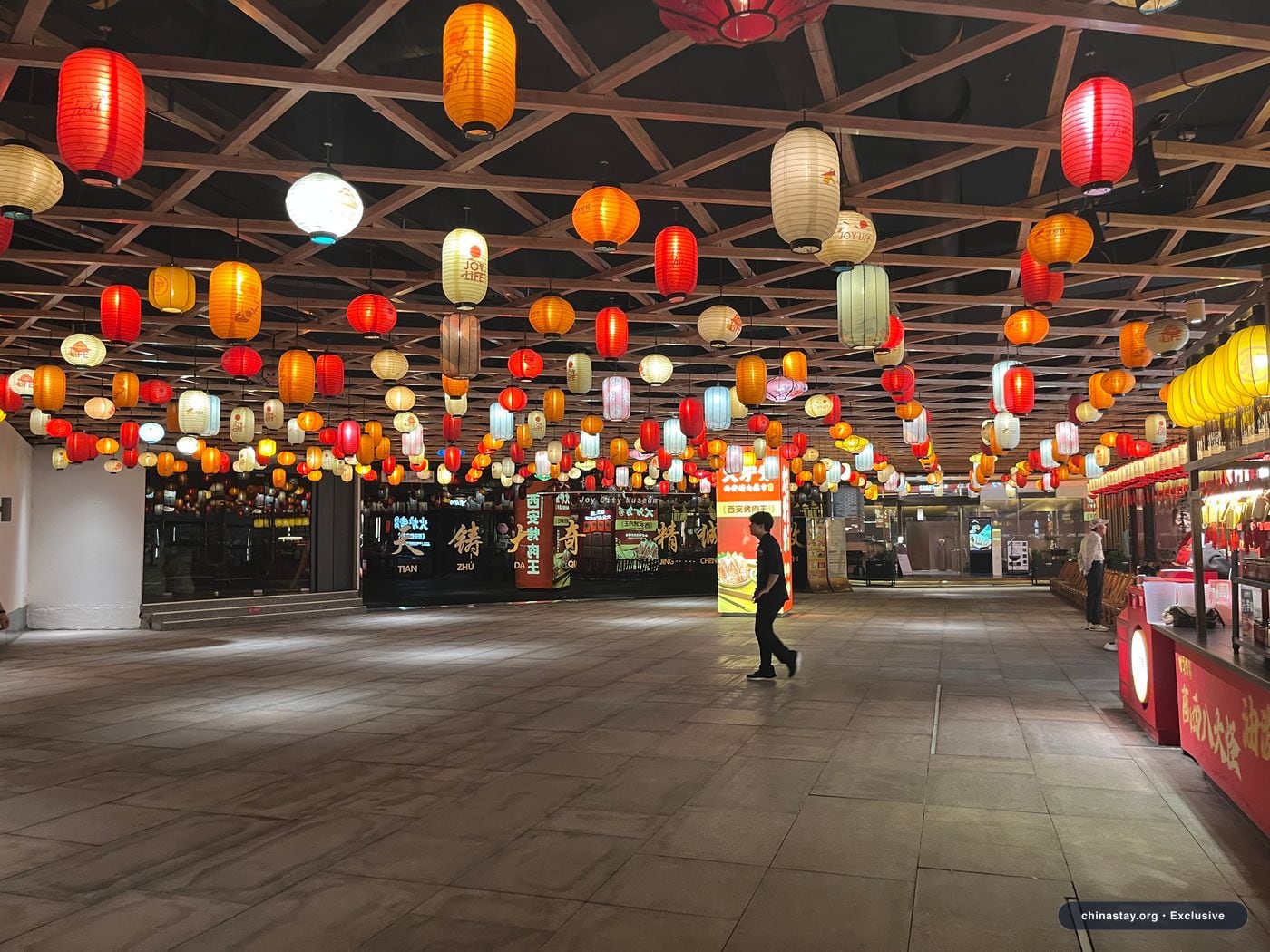 Hundreds of illuminated lanterns suspended beneath the wooden trellis of the Joy City shopping district adjoining the south square.
Along the side avenues flanking the pagoda, hundreds of boutiques offer hanfu rental (汉服体验). For roughly ¥150 to ¥250, stylists drape you in flowing Tang dynasty silk robes, pin your hair into dynastic updos, and apply mineral makeup with forehead floral decals (huadian). Strolling down the avenue in period attire surrounded by thousands of others doing the exact same thing creates an infectious sense of shared pageantry. Freelance photographers roaming the avenue offer professional portrait sessions for around ¥200, delivering edited digital photos within hours.
Planning your movement makes all the difference here. Skip taxis and ride-hailing completely between 18:00 and 22:00, as traffic along South Yanta Road grinds to a total standstill and parking is nearly impossible. Take Xi’an Metro Line 3 or 4 directly to Dayanta Station (大雁塔站) and use Exit B or C to emerge right onto the north square. Wear comfortable walking shoes, carry a power bank, and visit on a Tuesday or Wednesday evening to avoid peak weekend crowds.
When the ground-level crush grows dense, slip into the Joy City (大悦城) shopping complex directly opposite the south plaza. Ride the escalator up to the fourth-floor open-air terrace. From this elevated vantage point, you can enjoy a tranquil, unobstructed view of the golden Big Wild Goose Pagoda soaring above the lantern-lit rooftops without being jostled by elbows. Furthermore, international visitors can relax about spending: all 299 licensed merchants across the Datang Everbright City promenade accept international Visa, Mastercard, and JCB directly at their point-of-sale terminals.
2. Where Locals Actually Eat: Back Alleys and Residential Blocks
Guidebooks routinely steer visitors toward the neon-lit central spine of Huimin Street (回民街), located directly behind the Drum Tower. That main strip has evolved into a standard commercial market selling mass-produced squid skewers and boxed sweets. The genuine soul of Shaanxi food thrives in the residential alleyways and quiet compounds where multi-generational cooks feed their own neighbors.
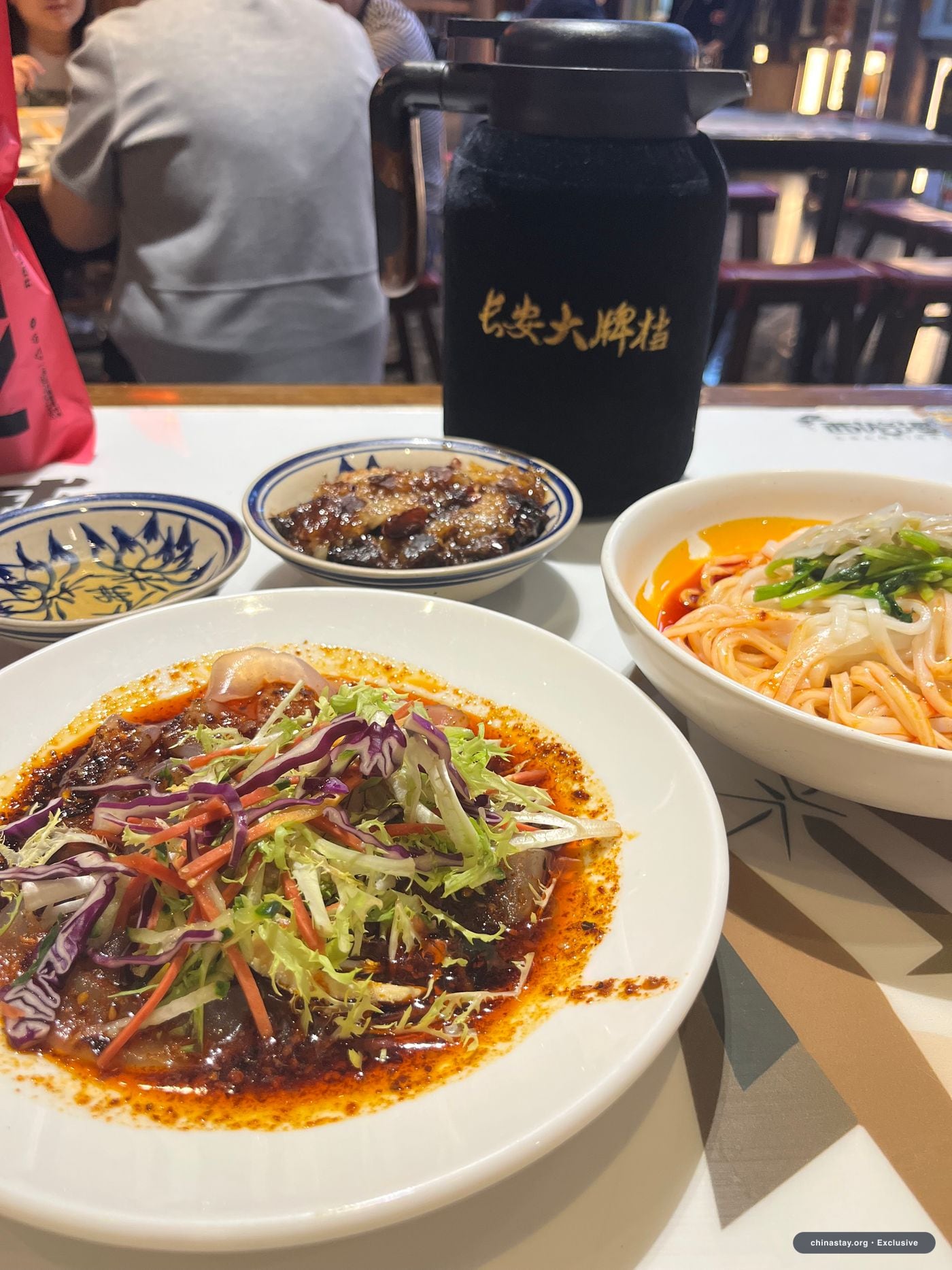 A traditional feast at Chang’an Da Pai Dang: hand-pulled cold liangpi, sticky rice zenggao, and seasonal side dishes.
Xi’an’s signature roujiamo (肉夹馍)—tender, slow-simmered spiced pork belly chopped fine and stuffed into a freshly griddled, crispy flatbread (baijimo)—reveals its finest form at Qin Yu Roujiamo (秦豫肉夹馍) on Dongmutoushi. Arrive early in the morning. The bakers produce flatbreads marked by crisp concentric rings that shatter audibly on the first bite, revealing fragrant, meltingly tender pork soaked in savory cooking broth. Order the youzhiluo (a succulent balance of lean and fatty pork) accompanied by a bowl of warm vermicelli soup. They open at 07:00 and close the instant the pork runs out, usually around 13:00. For another stellar rendition, head to the original branch of Ziwulu Zhang Ji (子午路张记) on Cuihua Road, where the crust is robust and generously stuffed with spiced braised meat.
Barely 500 meters southwest of the Bell Tower lies Zhonglou Community (钟楼小区), a low-rise 1980s residential neighborhood untouched by tourist markups. A morning stroll through its plane-tree courtyards lets you put together a feast for under ¥35. Start with a warm box of freshly baked mung bean pastries at Zhao Ji (赵记绿豆馅饼), where a paper-thin crust holds a velvety, delicate filling. Follow that with a hearty bowl of braised beef rice at Chen Liji (陈丽记), or share a bowl of spicy shredded chicken noodles at Yu Ze (余泽香辣面).
For breakfast connoisseurs, the old quarter of Xuanfengqiao (玄风桥) offers pure morning comfort. Order a steaming bowl of spicy pepper beef soup (hulatang) studded with tender beef meatballs and seasonal vegetables at Ma Laosi, tearing off pieces of warm scallion pancakes to dip into the peppery broth. Pair it with a fresh sesame flatbread pulled straight from the tall drum oven at San Xiongdi.
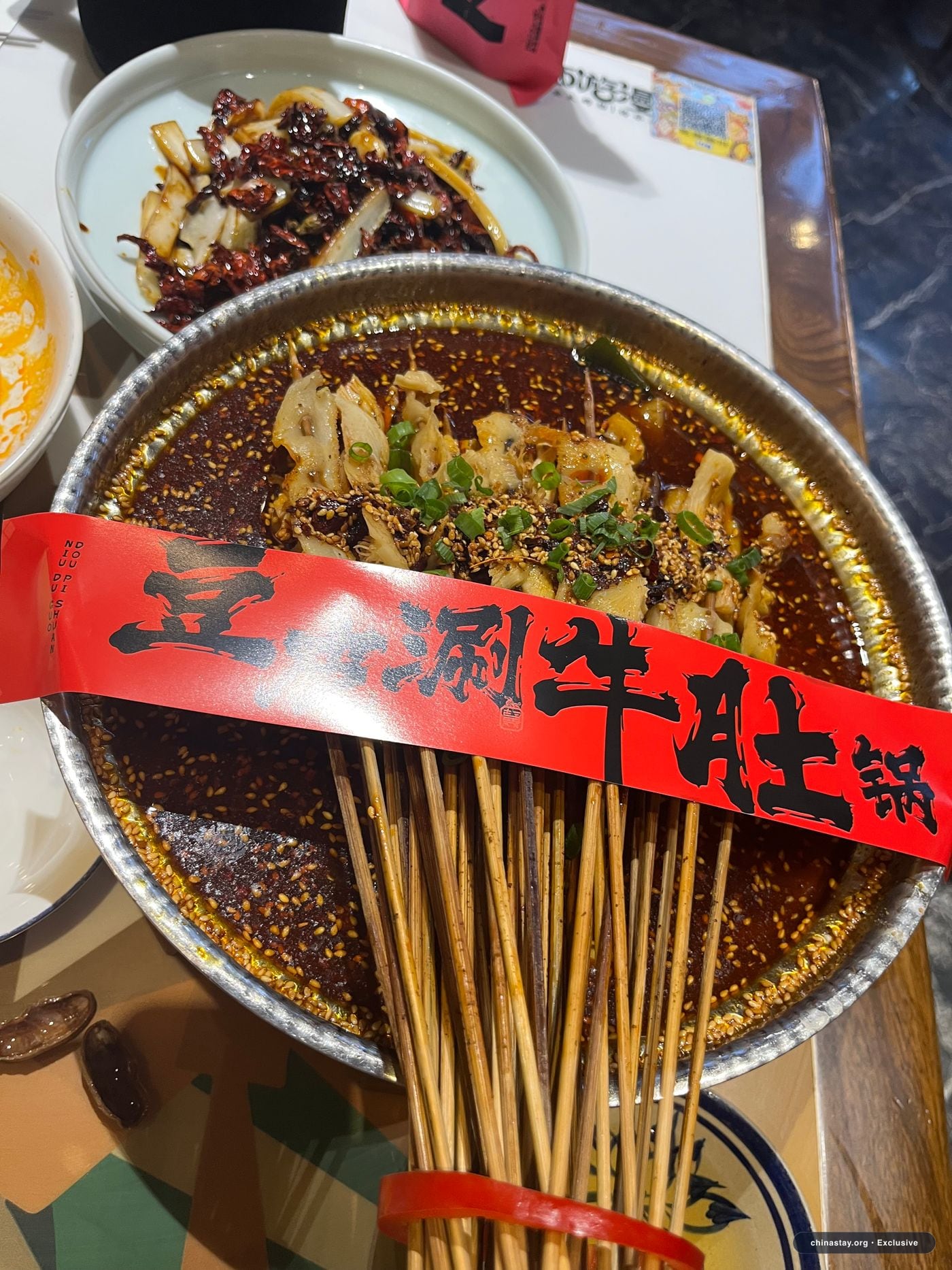 Shaanxi Shuan Niu Du (涮牛肚): tender skewers of beef tripe smothered in roasted sesame paste and aromatic chili oil.
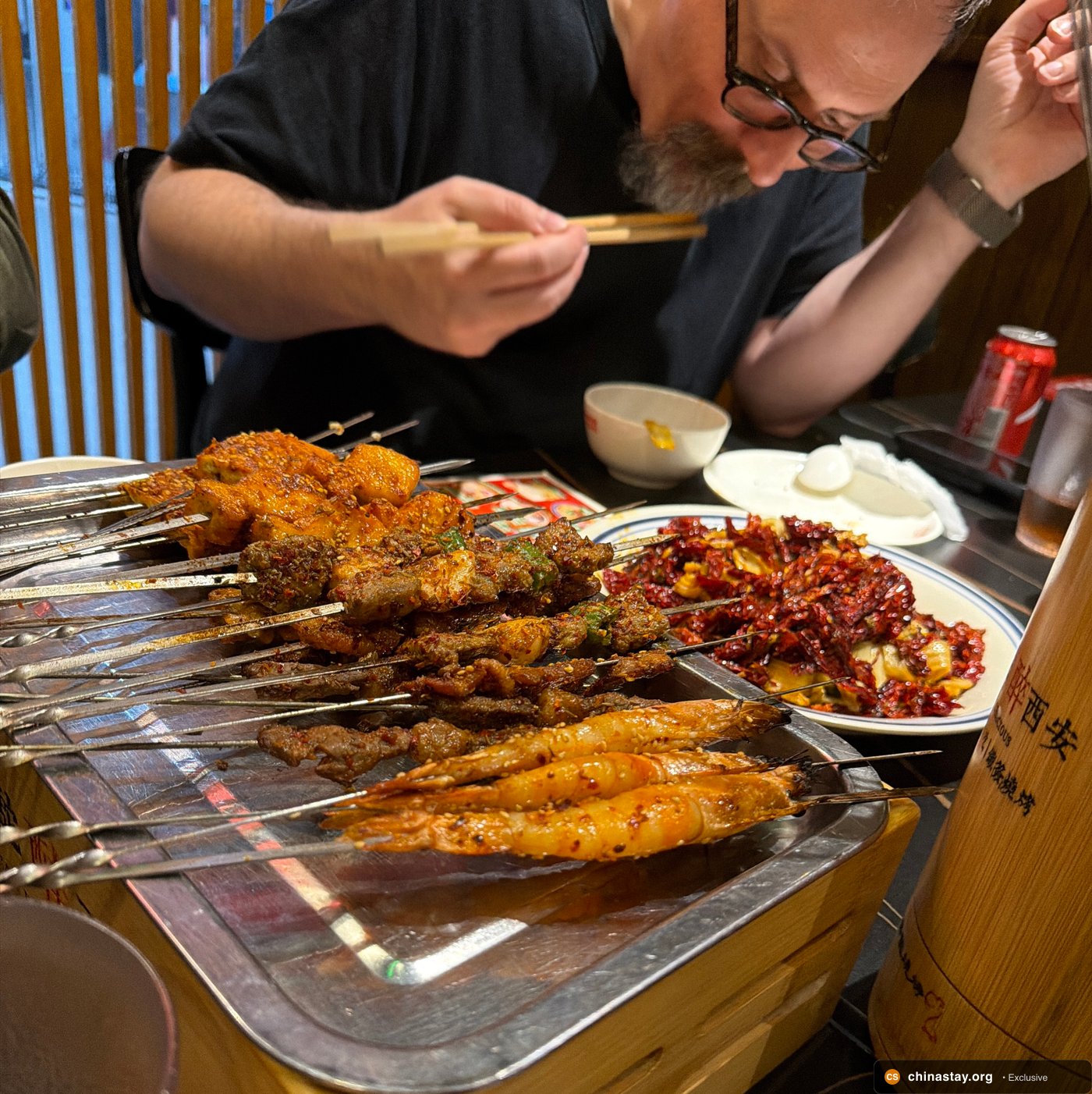
Deeper inside the Muslim Quarter, bypass the main thoroughfare and navigate into the residential lanes of Dapiyuan (大皮院) and Xiyangshi (西羊市). Here, neighborhood grill masters run institutions like Guo Nan BBQ (郭楠烤肉), where diners sit on miniature plastic stools on the pavement while cooks grill skewers over glowing charcoal. Beef and tendon skewers run roughly ¥1.2 each, dusted in ground cumin, salt, and roasted chili powder. Down an adjacent alleyway, Er Bu BBQ (尔卜烤肉) serves legendary 1-yuan beef skewers to a devoted local following. For dumpling lovers, Ma Ru (马茹酸汤水饺) folds delicate mutton dumplings served in piping-hot broth spiked with aged Shanxi vinegar, roasted chili oil, dried seaweed, and toasted sesame seeds. If you prefer milder heat, simply tell the staff “shao la” (少辣 - less spicy) when ordering.
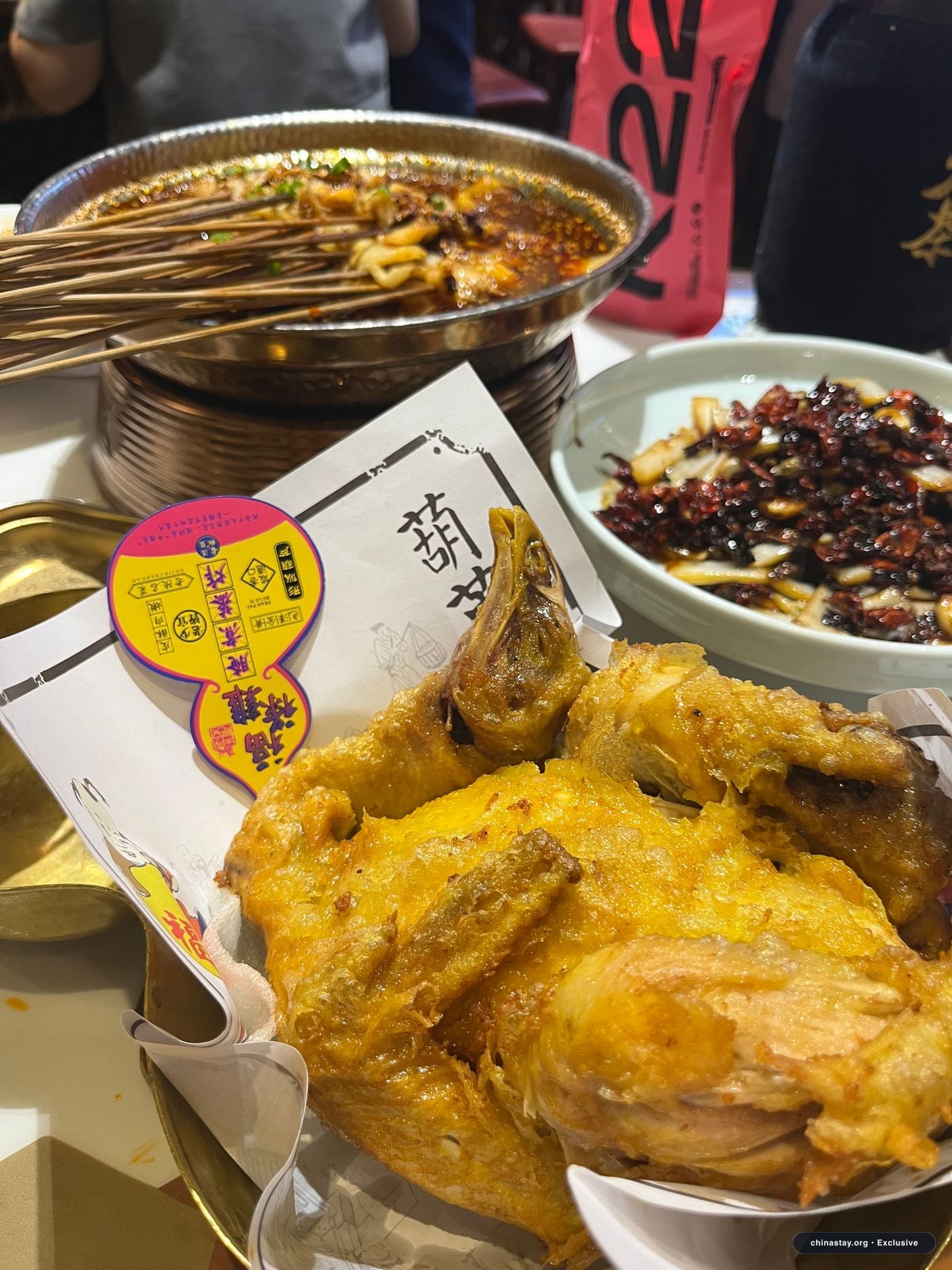 Hulu Chicken (葫芦鸡): a legendary Tang dynasty banquet specialty with paper-thin crisp skin and tender meat.
When you want an unhurried, sit-down banquet, seek out Hulu Chicken (葫芦鸡). Created in the aristocratic kitchens of the Tang Dynasty, the dish requires boiling, steaming, and deep-frying a whole young chicken in sequence. The skin turns paper-thin and crackles like pastry, while the meat stays tender and pulls away effortlessly from the bone. Dip each morsel lightly in roasted chili salt.
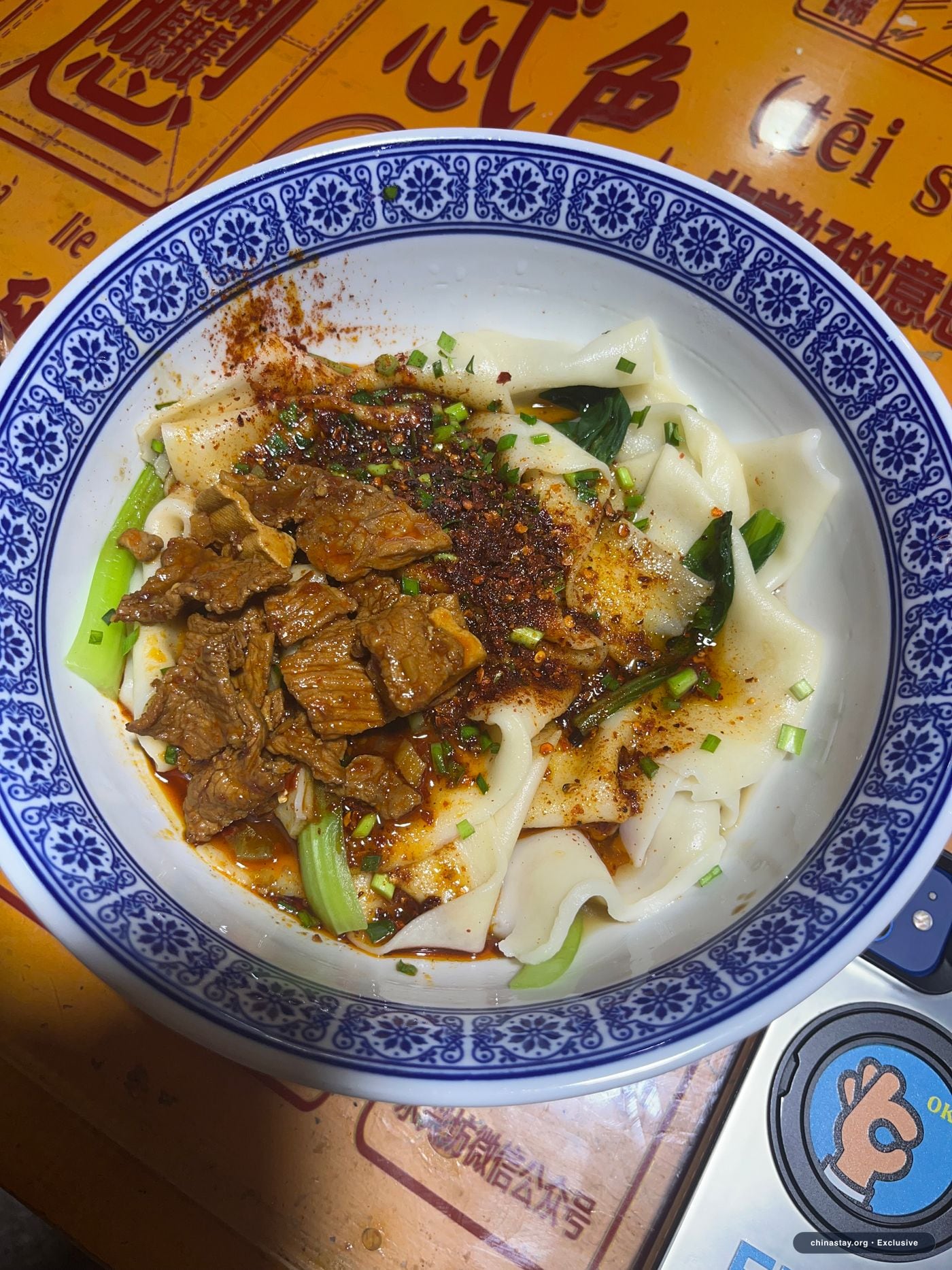 Freshly prepared Biangbiang noodles: wide, chewy belt noodles topped with slow-braised beef chunks, greens, and sizzling youpo chili oil.
Equally essential is sitting down before a steaming bowl of hand-pulled Biangbiang noodles (biángbiang面). The name echoes the rhythmic slapping sound of dough striking the prep counter as the chef stretches it into wide, chewy ribbons resembling leather belts. Boiled al dente and heaped with slow-braised beef chunks, blanched greens, minced garlic, and vibrant chili powder, the bowl meets its defining moment when the chef ladles smoking-hot vegetable oil over the spices. The sizzle releases a mouthwatering cloud of fragrant chili aroma right before you toss the noodles with your chopsticks.
3. Historic Courtyards and Folk Puppetry
A short walk off the northern stretch of Beiyuanmen brings you to Gao’s Grand Courtyard (高家大院), a 400-year-old residential compound of seven courtyards and 86 rooms. Built during the Ming Dynasty, it belonged to Gao Yuesong, a prominent scholar-official who placed second in the imperial examinations under the Chongzhen Emperor.
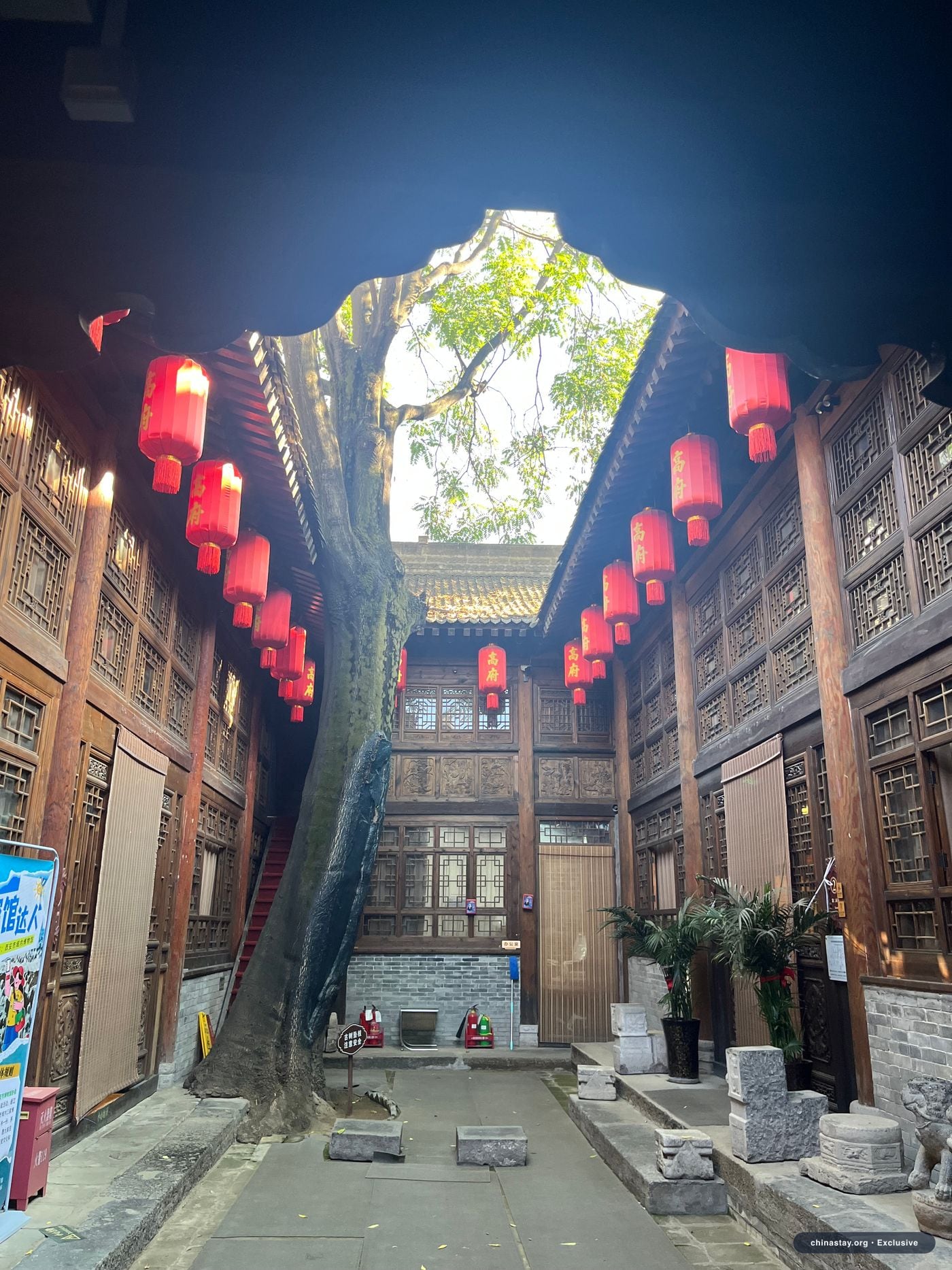 The interior courtyard of Gao’s Grand Courtyard, shaded by a multi-century-old scholar tree and decorated with traditional red lanterns.
Passing through the tall stone threshold immediately shuts out the street clamor. The compound preserves exquisite brick carvings, upturned eaves, and dark wooden lattice windows that filter gentle courtyard light. Shaded by a centuries-old scholar tree, the central courtyard offers an intimate perspective on domestic life during the late imperial era.
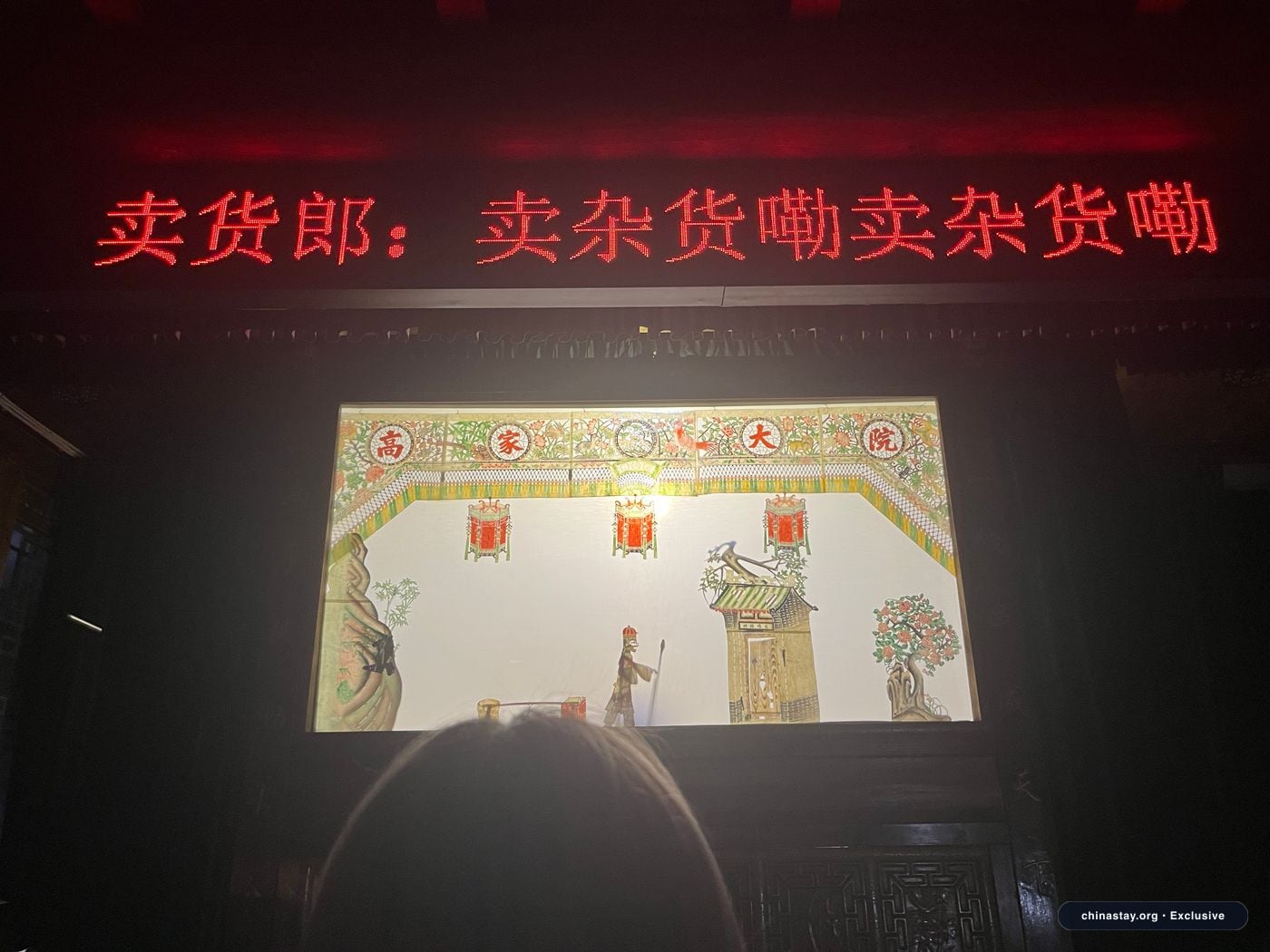 Live Shaanxi shadow puppetry (皮影戏) performed behind an illuminated parchment screen inside Gao’s Grand Courtyard.
In a cozy timber hall toward the back, master performers stage daily shows of Shaanxi Shadow Puppetry (华州皮影戏). Hand-carved from translucent cowhide, the articulated figures dance across an illuminated parchment screen to the accompaniment of clacking wooden clappers and resonant Qinqiang vocal melodies. Watching the itinerant merchant (Maihuolang) banter and bargain across the screen keeps an oral folk art alive that has entertained Shaanxi audiences for over two thousand years.
4. Hidden Sanctuaries: Xi’an Without the Crowds
While tour buses line up outside the Shaanxi History Museum, several of Xi’an’s most evocative cultural landmarks remain blissfully uncrowded.
Tucked into the northwest corner of the Ming City Wall, Guangren Temple (广仁寺) was constructed in 1705 by the Kangxi Emperor to lodge Tibetan Buddhist dignitaries traveling to Beijing. As the sole Tibetan Buddhist monastery in Shaanxi province, it greets visitors with deep crimson perimeter walls, gilded prayer wheels, and a white stupa soaring above stone courtyards. Admission is free, pine needles scent the air, and quiet monk chants replace the hum of city traffic.
Just inside the South Gate (Yongningmen) lies Shuyuanmen, a flagstone avenue lined with antique shops selling wolf-hair calligraphy brushes, carved inkstones, and stone steles. In the middle of the lane stands Guanzhong Academy (关中书院), founded in 1592 as Shaanxi’s preeminent Confucian academy. Visitors can freely wander through its restored lecture pavilions, tranquil bamboo groves, and stone courtyards without tickets or queues.
Directly opposite the South Gate ramparts, Xiangzi Temple (湘子庙) is a quiet Daoist sanctuary reputed to be the ancestral home of Han Xiangzi, one of the Daoist Eight Immortals. Locals come to light incense for harmony and romance. Stepping out the temple gate lands you directly in Defu Lane (德福巷), Xi’an’s historic bar street. In the afternoon, its European-style brick townhouses host relaxed independent coffee shops, transitioning by dusk into craft beer taprooms pouring Shaanxi fruit ciders and local IPAs.
In the southern Qujiang district, Qin Er Shi Mausoleum (秦二世陵遗址公园) stands as the quietest historical park in urban Xi’an. The grounds contain the burial mound of Huhai, the second Qin emperor whose short reign precipitated the fall of China’s first unified empire. Expressive bronze statues narrate the dynasty’s dramatic rise and collapse amid open lawns and quiet walking paths. From late October through mid-November, the park’s mature ginkgo trees turn luminous gold, carpeting the stone pathways in yellow leaves.
South of the city in Chang’an District, Shaanxi Archaeology Museum (陕西考古博物馆) is China’s first museum devoted specifically to the scientific discipline of archaeology. The exhibits guide you straight through open excavation trenches, soil stratigraphy cross-sections, and forensic restoration laboratories. Over 90% of the artifacts on display are making their public debut. Admission is free with an advance passport booking, and the museum closes on Mondays.
If you crave an afternoon break from ancient dynasties, head to Dahua 1935 (大华1935) near Daming Palace. Once the largest mechanized cotton mill in northwestern China, the 1930s industrial site preserves red-brick sawtooth factory halls and towering brick chimneys, repurposed into art spaces, experimental theatres, and quiet cafes.
5. Morning Markets: Waking Up Like a Local
To experience everyday life in Xi’an, set your morning alarm for 06:30.
Running along the interior base of the South Gate wall from dawn until about 09:00, Xiaonanmen Morning Market (小南门早市) bustles with community energy. Neighborhood residents gather to buy fresh produce, fish, and breakfast. Squeeze onto a wooden stool beside local elders to try Youcha Mahua (油茶麻花), a savory porridge made from roasted flour scented with ground sesame, Sichuan peppercorns, and walnuts, topped with crisp fried dough twists that soften as they absorb the broth. Next to it, try Zenggao (甑糕), a warm, fragrant cake steamed inside a traditional earthenware vessel (zeng). Alternating layers of glutinous rice, sweet red dates, and kidney beans melt together into a dense, chewy purple treat.
On Thursday and Sunday mornings, visit Xicang Flea Market (西仓市集) near the West Gate. Operating for over a century, this labyrinth of open-air stalls draws retirees trading songbirds in bamboo cages, vintage watches, antique coins, cricket gourds, and curiosity pieces. It offers an authentic slice of old Chang’an street culture rarely documented in standard guidebooks.
6. The Heavyweight Icons: How to Do Them Right
Xi’an’s world-renowned monuments deserve their fame. Experiencing them smoothly simply takes the right timing and approach.
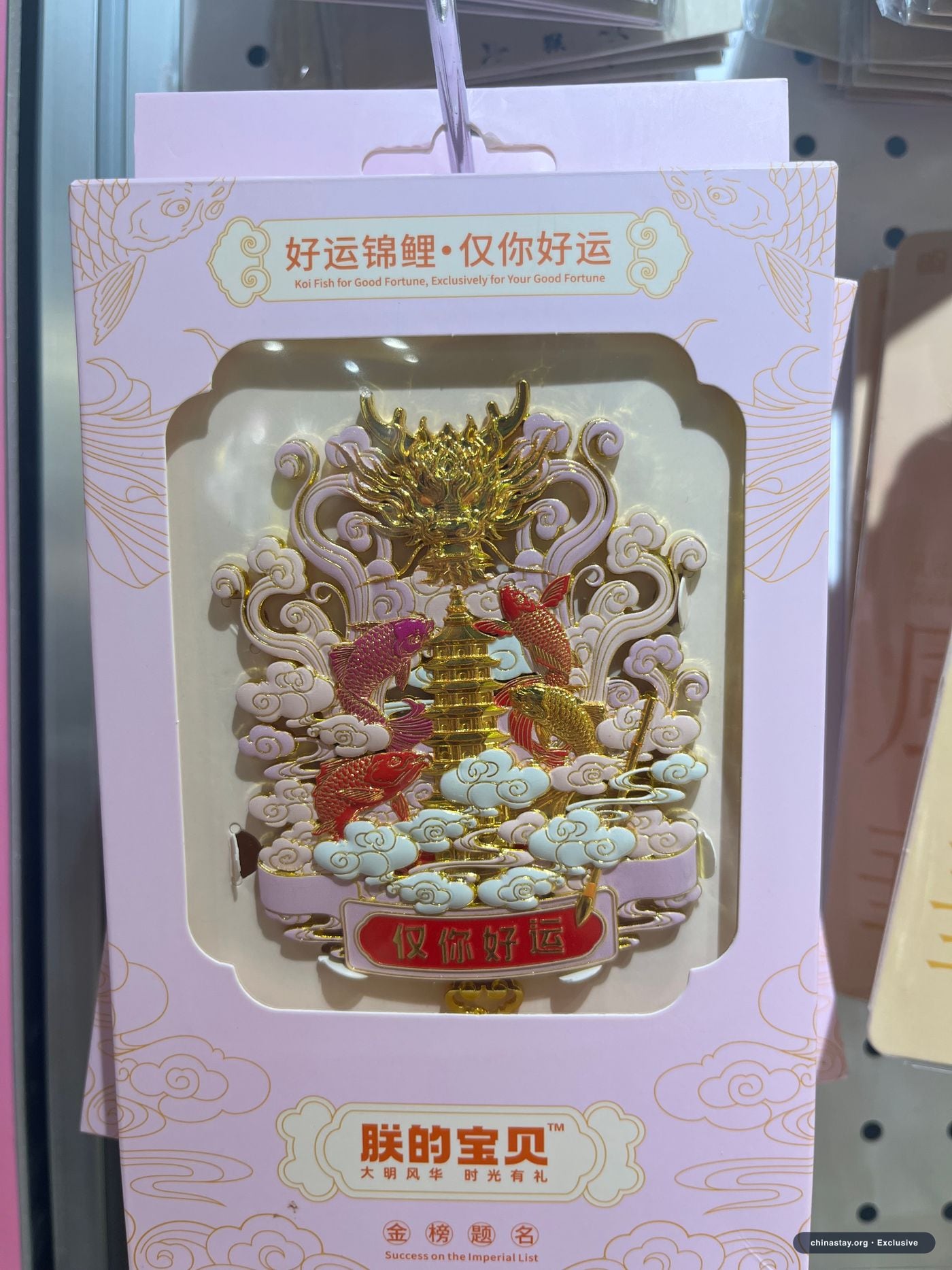 An intricate gilded keepsake magnet featuring the Big Wild Goose Pagoda and auspicious leaping carp.
Xi’an’s Ming City Wall forms the most intact ancient urban fortification on the planet, rising 12 meters high with a rampart width of 15 to 18 meters. While walking the full perimeter can be exhausting, renting a single-speed cruiser on the wall (around ¥45 for two hours) is pure pleasure. Enter at the South Gate (Yongningmen) around 17:00 to complete the 14-kilometer circuit during golden hour. As the sun sets, warm light washes across the stone watchtowers, creating a striking contrast between the lantern-lit tiled roofs of the old city on one side and the modern glass skyline on the other.
Located 40 kilometers east in Lintong, the Terracotta Army (兵马俑) of Emperor Qin Shi Huang is essential viewing. Reserve official tickets several days in advance through Trip.com or WeChat. To manage crowd flow effectively, enter Pit 1 first to take in the sheer majesty of thousands of life-sized soldiers in battle formation, proceed through Pit 3 (the military headquarters), and finish in Pit 2 to inspect the detailed Kneeling Archer at eye level.
While most people associate giant pandas with Chengdu, the Qinling Mountains of Shaanxi shelter a distinctive native subspecies with rounder skulls and shorter snouts. More uniquely, Shaanxi is home to Qizai (七仔), the world’s only brown-and-white giant panda in human care. Qizai lives at the Qinling Four Treasures Science Park (秦岭四宝科学公园) in Zhouzhi County, about an hour’s drive southwest of the city. Plan to arrive at the gates by 09:00 AM. Pandas are energetic and feed on fresh bamboo during the cool morning air; by 10:30 AM, Qizai reliably retreats for a long nap beneath his wooden shelter.
7. Practical Logistics & Survival Advice
High-speed trains arrive at Xi’an North Railway Station (西安北站). Skip the taxi queues and take Metro Line 2 or 14, which connect directly to central stops like Bell Tower and Dayanta in roughly 30 minutes.
For effortless transit, open the Alipay app and activate the “Xi’an Metro Card” (西安电子地铁卡). Scanning the generated QR code at subway turnstiles charges your linked international credit card directly, eliminating the need to buy single-ride tokens.
Late autumn—specifically late October through mid-November—delivers the pleasantest travel weather, featuring clear skies, mild afternoons, and golden ginkgo foliage across temple courtyards. Midsummer visits in July and August require caution, as midday temperatures regularly exceed 38°C (100°F). During hot months, explore temples and morning markets before 09:00, take refuge in air-conditioned museums through the afternoon, and resume street explorations after 18:30 when the city cools down and the night lanterns illuminate.
Curator of China Nomad Guide. Specializing in bespoke route architecture, bilingual on-the-ground fixer services, and neutral medical/dental tourism logistics. Based between Chengdu, Yunnan, and Shanghai.
Get the China Stay China Arrival Kit & Checklist
Don’t get locked out without connectivity or payment at the border. Instant access to our interactive 12-step field guide + offline 1-page PDF printable cheat sheet covering pre-flight eSIMs, foreign card Alipay binding, PSB police registration, and railway ticketing.
Curated by Villanelle (IG: @v.forvillanelle • hello@chinastay.org). Zero spam.