In the global software ecosystem, “vibe coding” with autonomous terminal agents—from Claude Code and Cursor to OpenAI Codex—has dramatically flattened the cost of writing code. You can prompt a working web application into existence in an afternoon from a cafe in San Francisco, Bali, or Berlin.
Yet the moment your software touches the physical world—requiring tactile switches, rotary encoders, wireless microcontrollers, custom enclosures, or multi-layer printed circuit boards—you collide headfirst with the brutal inertia of Western hardware supply chains.
In Silicon Valley or London, a single custom 4-layer PCB revision often requires three weeks of back-and-forth emails, minimum order quantities (MOQs) that punish small batches, and thousands of dollars in air freight. If you design a footprint wrong or miscalculate a passive capacitor rating, your entire development sprint is frozen for a month.
In Shenzhen, that exact same iteration cycle happens within 24 hours.
Physical Speed Arbitrage: PCB Prototyping Turnaround
21x Velocity Multiplier
Western Supply Chain (SF / London / Berlin)
~21 Days TurnaroundWeek 1 Gerber DFM checks & distributor quotes (3–5 days)
Week 2 Batch queuing, board fabrication & SMT assembly
Week 3 Air freight, customs clearance & deskside delivery
Shenzhen & PRD Ecosystem (On-The-Ground)
24-Hour Loop18:00 (Day 0) Gerber & BOM upload via domestic JLCPCB / LCSC
22:00 (Overnight) Laser stencil cutting & automated multi-line SMT
10:00 (Day 1) Optical AOI test & same-day SF Express dispatch
16:00 (Day 1) Populated boards on your workbench for flashing
When bringing VibeKeys—a line of physical tactile keypads and rotary controllers built specifically for developers interacting with AI coding loops—from concept to market, software and USB HID firmware were architected remotely. But when engineering the flagship VibeKeys Max, which required custom multi-layer PCB routing, OLED display telemetry, and tactile rotary encoders, 1 former hardware engineer packed an oscilloscope and laptop and flew solo to Shenzhen.
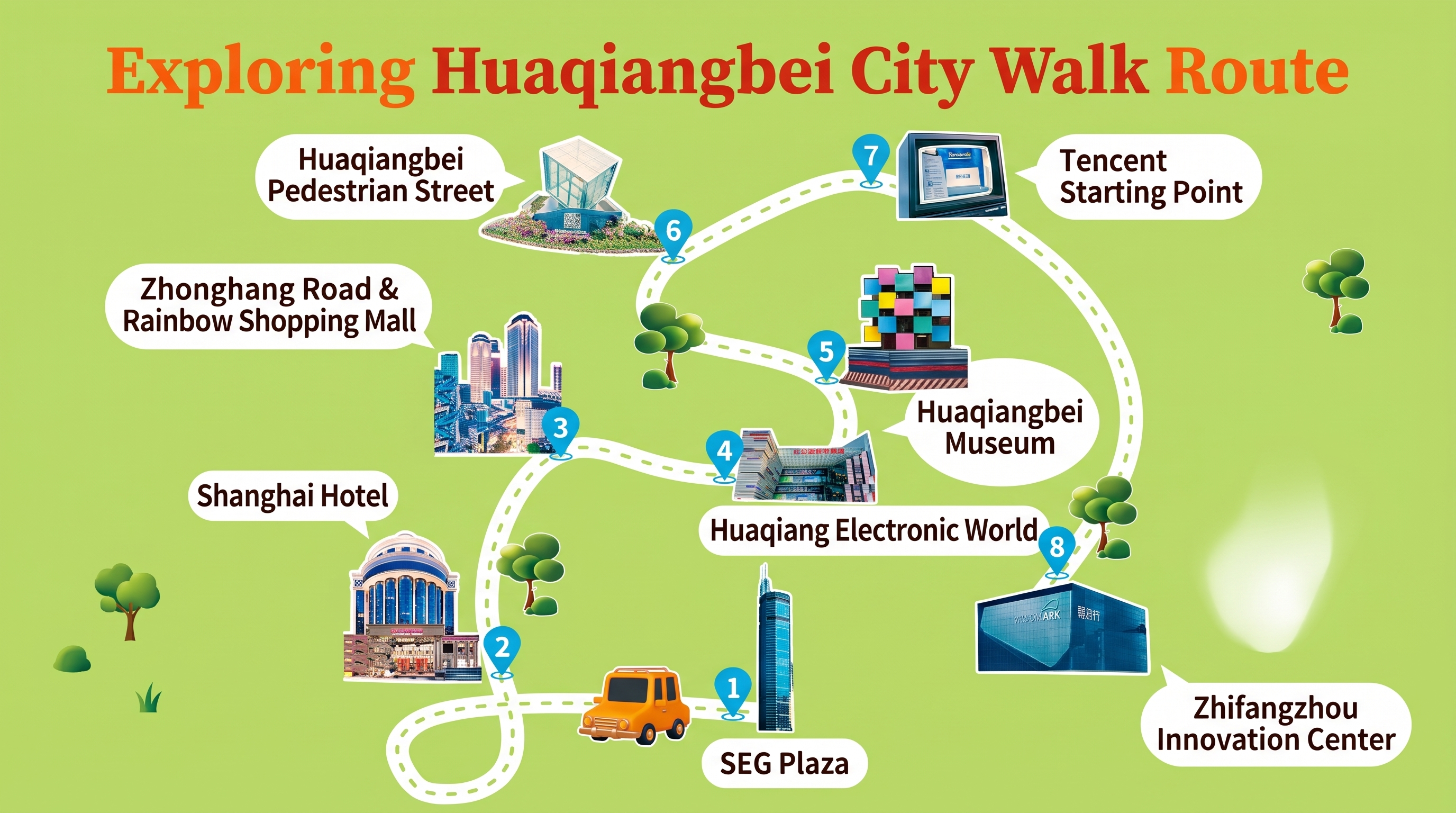
Being physically on the ground in Shenzhen meant that when a critical low-noise LDO voltage regulator was out of stock online, he didn’t wait two weeks for an international distributor shipment—he took Shenzhen Metro Line 2 straight to SEG Plaza in Huaqiangbei, bought a cut tape of 50 chips directly off a counter stall for ¥40 CNY ($5.50 USD), hand-soldered them onto a fresh board at his workbench, and verified the prototype before midnight.
This is Physical Speed Arbitrage. If you are building physical computing devices, IoT appliances, robotics, or AI hardware, Shenzhen provides an indispensable physical operating system for rapid iteration.
1. Huaqiangbei Demystified: The Multi-Tower Directory
Foreigners often picture Huaqiangbei (华强北) as a single sprawling electronics flea market. In reality, it is a high-density commercial district spanning dozens of interconnected, multi-story wholesale towers, each specializing in distinct strata of the global electronics stack.
Walking in without a mental map is dizzying. Here is the exact building-by-building breakdown of where to find components, test equipment, and connectors:
Huaqiangbei Multi-Tower Sourcing Grid
Lines 2 & 7 (Huaqiang North) • Line 1 (Huaqiang Rd)
- Floors 1–2: Discrete active ICs, STM32, ESP32, Nordic BLE chips, sensors, operational amplifiers, crystal oscillators.
- Floors 3–5: Test instruments: Rigol/Siglent oscilloscopes, multimeters, DC programmable power supplies, soldering stations.
- Floors 6–10: Custom TFT/OLED displays, e-ink panels, industrial PC motherboards.
- Floors 1–3: Mechanical switches, tactile push buttons, rotary encoders, custom ribbon cables, JST/Molex connectors, USB-C breakout boards, heatsinks.
- Upper Floors: Second-hand laptops, repair parts, computer motherboards, specialized tools.
- Floors 1–3: High-volume surface-mount passives (SMD). Full reels & cut tape strips of 0402/0603/0805 resistors and ceramic capacitors.
- Components: Diodes, MOSFETs, transistors, and LDO voltage regulators.
- Specialties: Custom lithium-polymer (LiPo) battery packs with integrated protection circuits (PCM).
- RF & Optics: Miniature 2.4G/5G antennas, wireless charging coils, miniature camera modules.
4 Golden Rules for Counter Negotiations
- The 11:00 AM Opening Rule: Stalls do not operate on early-morning banking hours. Most counter owners arrive around 10:30–11:00 AM, process factory orders through early afternoon, and close by 18:30 PM. Arriving before 10:00 AM means staring at locked metal shutters.
- Bring a Physical Sample or Datasheet: Counter operators frequently speak limited English, but their component literacy is extraordinary. Show the exact package footprint (e.g.
QFN-32,SOT-23-5) and manufacturer part number (MPN) on your phone or bring a fried component. - Ask for “Yangpin” (Samples): Stalls primarily trade in reels of 3,000–5,000 units for factories. If you only need 5 or 10 pieces for prototyping, politely ask: “Keyi mai yangpin ma?” (可以卖样品吗? / Can I buy samples?). Most will cut a strip of 10 pieces for ¥10–¥30 CNY.
- Payment Mechanics: Counter stalls rarely accept international Visa or Mastercard. Ensure you have your international credit card linked to Alipay or WeChat Pay, or carry crisp ¥50 and ¥100 CNY banknotes for small cash trades.
2. The 24-Hour Physical Prototyping Loop
The true superpower of the Shenzhen ecosystem is not merely buying off-the-shelf components; it is the tight coupling between digital EDA software, bare PCB fabrication, Surface Mount Technology (SMT) pick-and-place lines, and rapid enclosure manufacturing.
Here is the exact operational playbook used by local hardware accelerators and foreign makers:
Step 1: Gerber & BOM Finalization
Design your board in KiCad, EasyEDA, or Altium. Ensure your Bill of Materials (BOM) specifies parts available on LCSC (立创商城) to take advantage of automated SMT library mapping.
Step 2: The Evening Submission (Before 18:00)
Submit your Gerber and centroid placement files to JLCPCB (嘉立创) or a specialized quick-turn board house in Bao’an. Standard 2-to-4 layer FR4 boards ordered with “expedited 24h fabrication” enter production that same evening at high-throughput facilities in Huizhou or Bao’an.
Step 3: Rapid Enclosure Machining
While your boards are being etched and baked, submit your 3D CAD files (STEP format) for custom housings:
- High-Detail Resin/Nylon (SLA/SLS): Local 3D printing farms in Shenzhen operate hundreds of industrial laser printers overnight. A clean prototype case costs ¥30–¥80 CNY ($4–$11 USD).
- CNC Billet Aluminum: For precision metal enclosures or custom tactile knobs, machine shops in Bao’an and Dongguan can mill bead-blasted, anodized aluminum prototypes within 48 hours.
Step 4: Same-Day Delivery via SF Express
By 14:00 to 17:00 the following afternoon, SF Express (顺丰速运) delivers your vacuum-sealed, populated PCBA boards directly to your apartment or coworking desk. You can assemble, flash firmware, and begin testing within 24 hours of laying down your final PCB trace.
3. Where to Base Yourself: Nanshan vs. Futian vs. Bao’an
Shenzhen is an elongated coastal metropolis stretching over 80 kilometers from east to west. Choosing the wrong district can leave you stranded in traffic or high-speed rail bottlenecks.
Shenzhen Tech Geography: West-to-East Corridor
- • High-speed SMT surface-mount lines
- • CNC machine shops & tooling makers
- • 3D printing clusters (SLA/SLS)
- • Shenzhen Bao’an Airport (SZX)
- • Tencent, DJI & AI venture labs
- • Kexing Science Park coworking hubs
- • Chaihuo Maker Space (Xili)
- • Coastal cafes & international community
- • Huaqiangbei multi-tower electronics market
- • SEG Plaza active IC counters
- • Futian High-Speed Railway Station
- • 14-min bullet train to HK West Kowloon
1. Nanshan District (南山) — The Software, AI & Community Hub
- Best For: Developers, AI engineers, and teams spending 70% of their time writing firmware, training models, and collaborating.
- Neighborhoods: Houhai (后海), Hi-Tech Park (高新园 / Kexing Science Park), and Xili University Town (西丽).
- Atmosphere: Home to Tencent, DJI, and hundreds of AI venture teams. Countless specialty coffee shops, unblocked enterprise co-working hubs, and leafy coastal walkways along Shenzhen Bay.
2. Futian District (福田) — Direct Hardware & Hong Kong Proximity
- Best For: Hardware builders who need daily, immediate access to Huaqiangbei stalls and frequent hops into Hong Kong.
- Neighborhoods: Huaqiang North (华强北), Chegongmiao (车公庙), and Gangxia (岗厦).
- Atmosphere: High-density commercial hub. Staying here puts you walking distance from SEG Plaza and 5 minutes from Futian High-Speed Railway Station, which reaches Hong Kong West Kowloon in just 14 minutes.
3. Bao’an District (宝安) — Factory Floors & Rapid Assembly
- Best For: Teams entering pilot production (50–1,000 units), testing injection molds, or supervising SMT surface-mount lines.
- Atmosphere: Industrial, pragmatic, and factory-dense. Less cosmopolitan cafe culture, but unmatched proximity to machine tooling shops and Shenzhen Bao’an International Airport (SZX).
4. Hackerspaces & Maker Hubs
Unlike pure digital nomad destinations where people gather solely to work from laptops, Shenzhen’s tech nomad infrastructure revolves around active creation:
- Chaihuo Maker Space (柴火创客空间): Founded by Seeed Studio, Chaihuo is Shenzhen’s legendary first maker space. Located in Xili, Nanshan, it features soldering stations, 3D printers, laser cutters, and an active international community of open-source hardware developers.
- InnoSpace Shenzhen: Located in the tech corridor, bridging hardware innovators with venture funding and supply-chain mentors.
- WeWork Kexing Science Park: Favored by cross-border AI and software engineers for its reliable high-speed networking, international community management, and direct proximity to Shenzhen’s top software talent.
5. Bridging the Gap: Why Technical Fixers Accelerate Your Runway
While simple off-the-shelf components can be purchased using translation apps and hand gestures, complex hardware development introduces friction points that software cannot easily solve:
- Factory Gate MOQs: When you visit an injection mold maker or SMT assembly house in Dongguan or Bao’an, Chinese manufacturers are accustomed to quoting orders in the tens of thousands of units. A seasoned bilingual fixer knows how to position your prototype run as a high-margin pilot batch, getting tier-one factories to take 50-unit prototype orders seriously.
- Component Counterfeiting & Lot Codes: In secondary markets, remarked microcontrollers and recycled capacitors exist. A technical local fixer inspects packaging tape, checks date codes, and steers you toward trusted authorized tier-one distributors in SEG.
- Tooling Tolerances & Contract Clarity: Misinterpreting an engineering drawing’s dimensional tolerance (e.g. ±0.05mm vs ±0.2mm) can ruin an entire pilot run of custom mechanical keycaps or enclosures. Having an on-the-ground bilingual advocate ensures technical specifications are respected before wires are cut.
Essential Practical Logistics
- Hong Kong Connection: Land at Hong Kong International Airport (HKG), take the Airport Express or cross-border minivan directly to the Shenzhen Bay or Lok Ma Chau border crossing. Total travel time is under 75 minutes.
- Cross-Border High-Speed Train: Futian Station connects directly to Hong Kong West Kowloon in 14 minutes on the bullet train (¥68 CNY / ~$9.50 USD). Keep your physical passport ready for combined immigration.
- Futian Summit Windows & Executive Transit: If your visit centers on Futian’s financial corridor, high-level meetings (including APEC 2026 summit controls around Xiangmihu), or APEC Business Travel Card (ABTC) entry rules, read our dedicated briefing on Shenzhen Executive Transit, Futian Security Zones & Hong Kong Border Corridors.
- Pre-Flight App Verification & Tax-Free Electronics: Before departing, ensure your foreign debit/credit cards are linked to Alipay and WeChat Pay, and verify your roaming travel eSIM works for unfiltered access. If buying electronics to take home—or packing foreign lithium chargers onto domestic mainland flights—check our Departure VAT Tax Refund Guide and 3C Power Bank Aviation Rules Guide.
Need On-the-Ground Technical Guiding in Shenzhen?
If your team is landing in Shenzhen to source components across Huaqiangbei, visit SMT assembly lines in Bao’an, or conduct supplier audits in Dongguan:
- Bilingual Tech Fixers & Factory Guides: Connect with certified technical interpreters who understand schematics, BOM spreadsheets, and factory negotiations:
👉 Hire a Private Tech Fixer in Shenzhen - Pre-Flight Route & Logistics Audit: If you need your travel itinerary, factory appointment schedule, or maker app stack audited before flying:
👉 Schedule a 45-Min 1-on-1 Pre-Flight Route Audit ($69)
Curator of China Nomad Guide. Specializing in bespoke route architecture, bilingual on-the-ground fixer services, and neutral medical/dental tourism logistics. Based between Chengdu, Yunnan, and Shanghai.
Get the China Stay China Arrival Kit & Checklist
Don’t get locked out without connectivity or payment at the border. Instant access to our interactive 12-step field guide + offline 1-page PDF printable cheat sheet covering pre-flight eSIMs, foreign card Alipay binding, PSB police registration, and railway ticketing.
Curated by Villanelle (IG: @v.forvillanelle • hello@chinastay.org). Zero spam.