Mention traveling to northern China in winter, and almost every guidebook points you squarely toward Harbin. What they omit is that Harbin’s Ice and Snow World has become a frantic gauntlet of neon queue fences, two-hour waits for outdoor ice slides, and selfie-sticks jostling under floodlights. It is a spectacle, certainly, but it is also a theme park.
If you crave the true, untamed Arctic frontier—where your eyelashes frost into delicate white lace within sixty seconds of stepping outside, where wild reindeer click softly through silence-blanketed larch forests, and where nomadic horsemen toast your health with fiery grain spirit inside felt yurts—you must look further north and west.
You must head to Hailar and the greater Hulunbuir steppe.
Perched at the northern cusp of Inner Mongolia, where the rolling Mongolian grasslands collide with the endless boreal forests of the Greater Khingan Mountains (Daxing’anling) and the Siberian border of Russia, this is China’s answer to Lapland. But unlike Scandinavian winter resorts that charge luxury surcharges for every reindeer pet, Hulunbuir remains raw, expansive, and delightfully unscripted.
Traveling here around New Year on an indie route like Straw Man Travel’s Song of Ice and Fire (Bing yu Huo zhi Ge), you experience a winter that feels ancient rather than packaged. Here is the definitive, ground-truth guide to navigating China’s frozen pole.
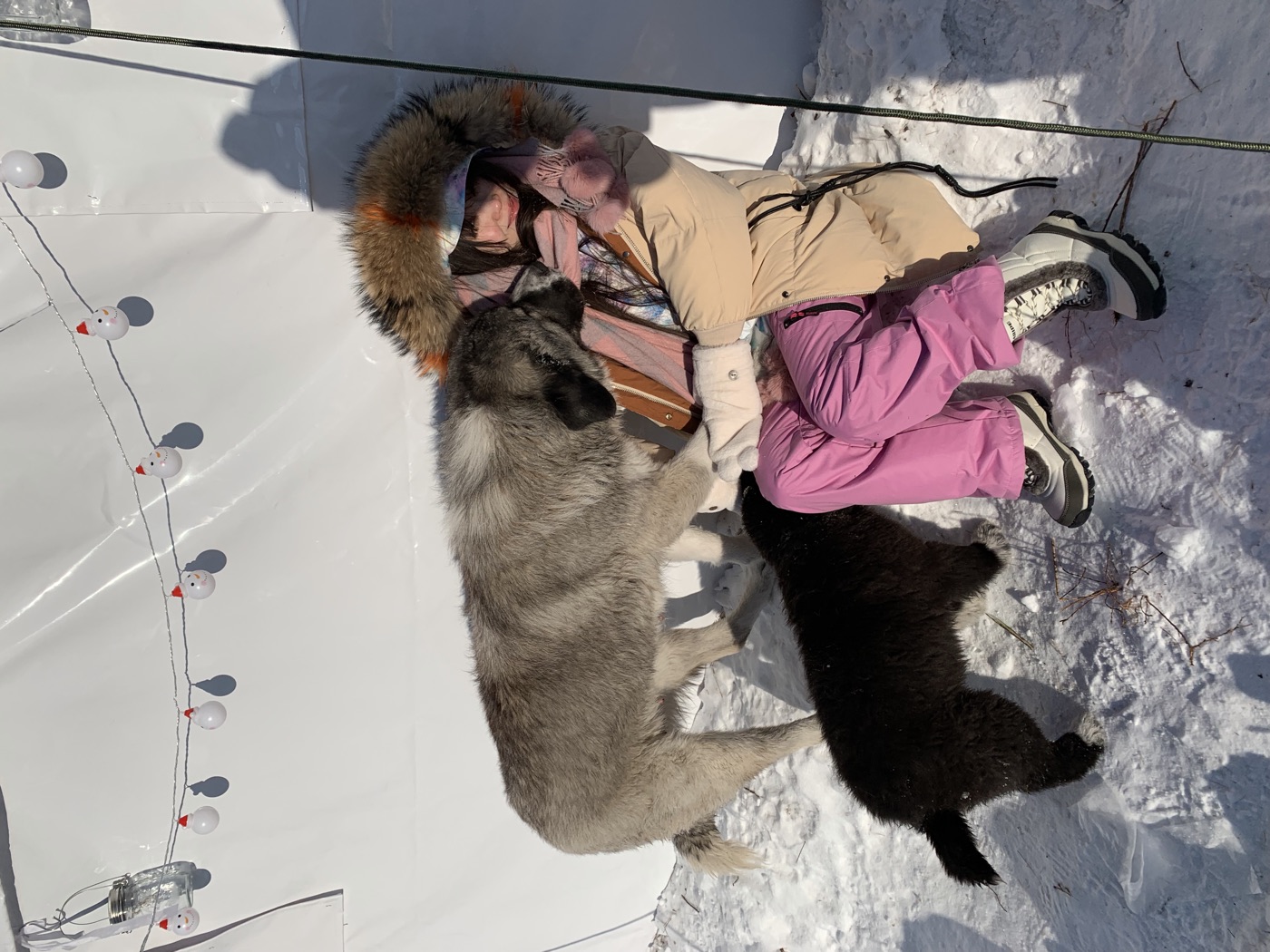
Warmth at twenty-five below zero: an affectionate silver Mongolian mastiff mother and her fuzzy black pup in the snow.
The Steppe in Winter: Yurts, Khoomei, and Mastiff Puppies
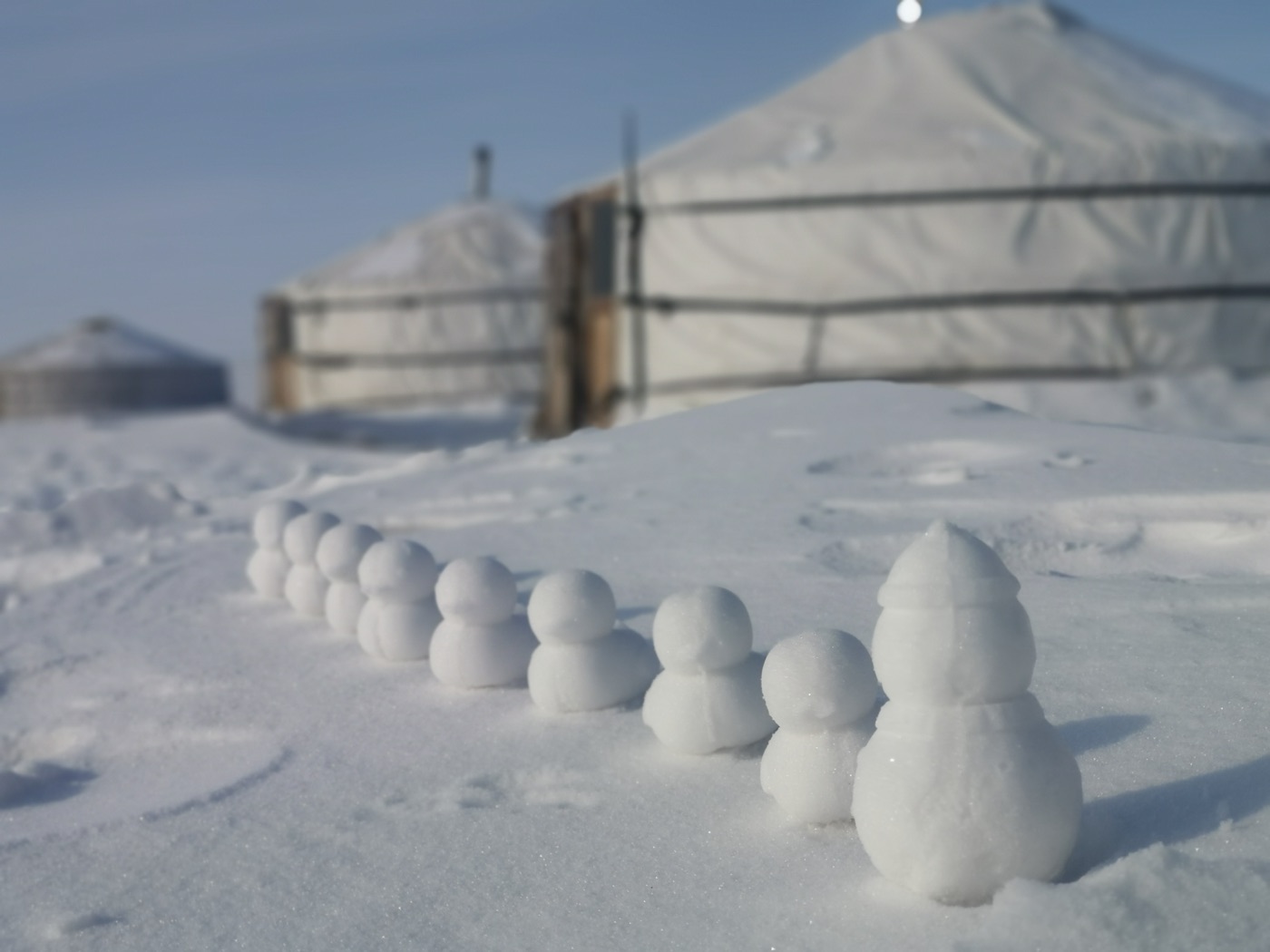
The journey begins on the vast, undulating plateau outside Hailar. In summer, these grasslands are an emerald sea grazed by hundreds of thousands of horses and sheep. In deep winter, the entire landscape is erased into an endless, blinding expanse of white beneath a sky of piercing, pale cobalt.
Stepping into a traditional felt Mongolian yurt (Ger) in this weather is an act of sensory salvation. Outside, the sub-zero wind howls across the steppe; inside, a cast-iron stove glows cherry-red in the center of the circular room, radiating intense heat fueled by dry firewood and dried birch bark.

Inside the felt yurt: learning the guttural polyphonic overtones of Khoomei throat singing from a master of the steppe.
Here, hospitality is immediate and unhurried. You gather around low wooden tables draped in gold brocade to learn the art of Khoomei (呼麦)—the astonishing Mongolian polyphonic throat singing where a single vocalist produces both a deep, rumbling drone from the stomach and an ethereal, whistling harmonic melody from the roof of the mouth simultaneously. When an elder sings, the sound vibrates through your very ribcage, evoking the spirit of galloping steppe horses and winter storms.
Between singing sessions, you learn the rolling shoulder shrugs and wrist sweeps of the traditional Mongolian dance, mimicking the flight of steppe eagles over the mountains.
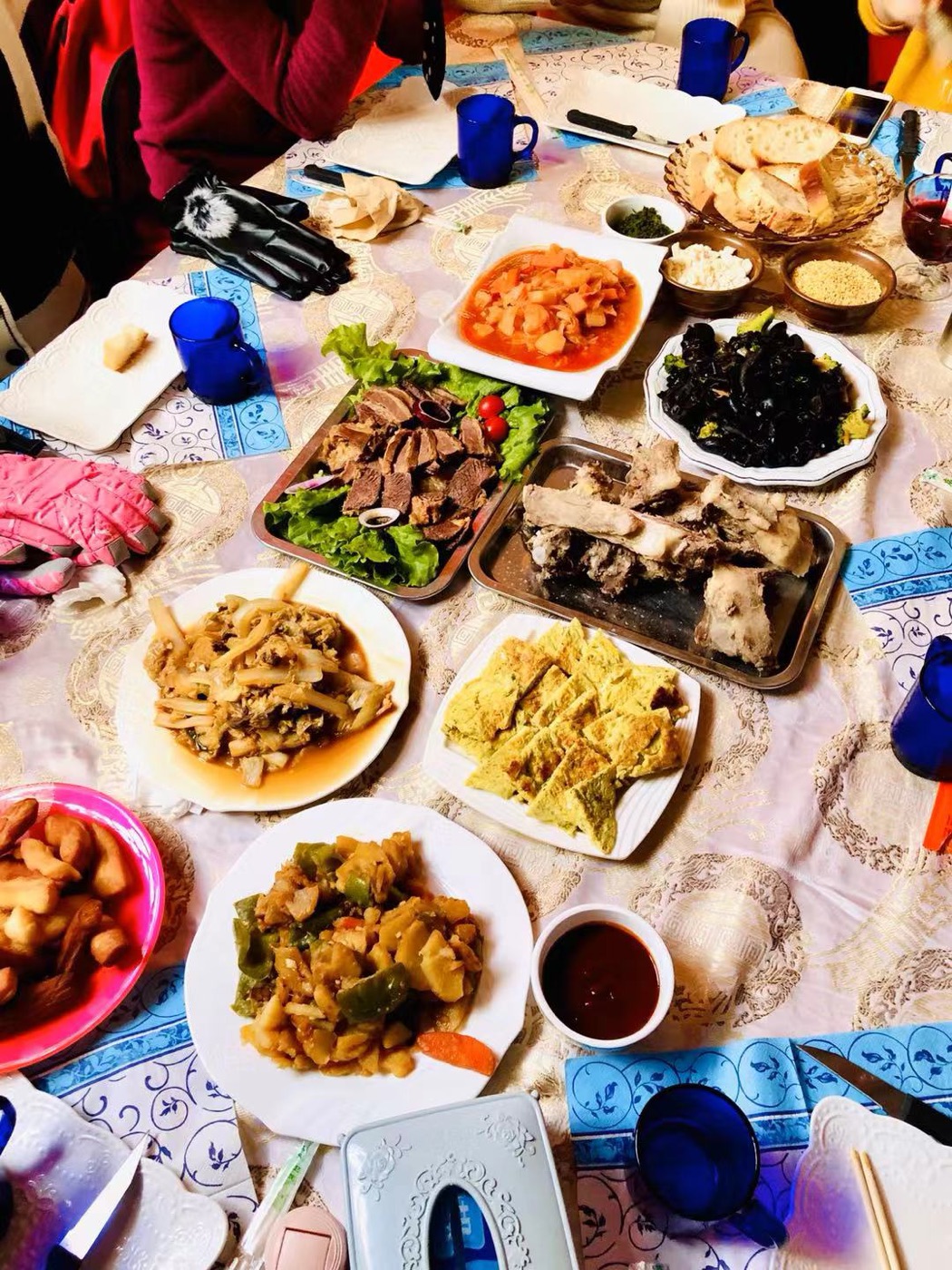
Steaming grassland fuel: hand-grabbed mutton ribs, crisp fried boortsog, and roasted millet milk tea served communal style.
The food matches the climate’s ferocity. In a heavy copper cauldron, the host toasts yellow millet in butter until fragrant, tossing in dried milk skins (Naipizi) before pouring boiling, rich milk tea over the mixture. Then come towering metal platters of Hand-Grabbed Mutton (Shoubaru).
These are pasture-fed Hulunbuir lamb ribs simmered in pure water with nothing more than coarse salt, wild scallions, and water. You hold the bone with one gloved hand, slice away morsels of tender, sweet meat with a small curved dagger, and dip each slice in wild leek flower sauce (Jiecaihua). There is zero gamy odor—only clean, restorative mountain fat.
Outside the yurt, life carries a surprisingly tender warmth. When you step out into the crisp yard, you meet the camp’s working herd dogs: a magnificent, silver-gray Mongolian mastiff mother and her tumbling, pitch-black puppy. After offering them a sliver of dried pork jerky from your pocket, all protective vigilance dissolves into pure affection. The mother mastiff leans her giant, fluffy head against your knee, gently licking your woolen mitten with hot breath that steams in the midday sun.
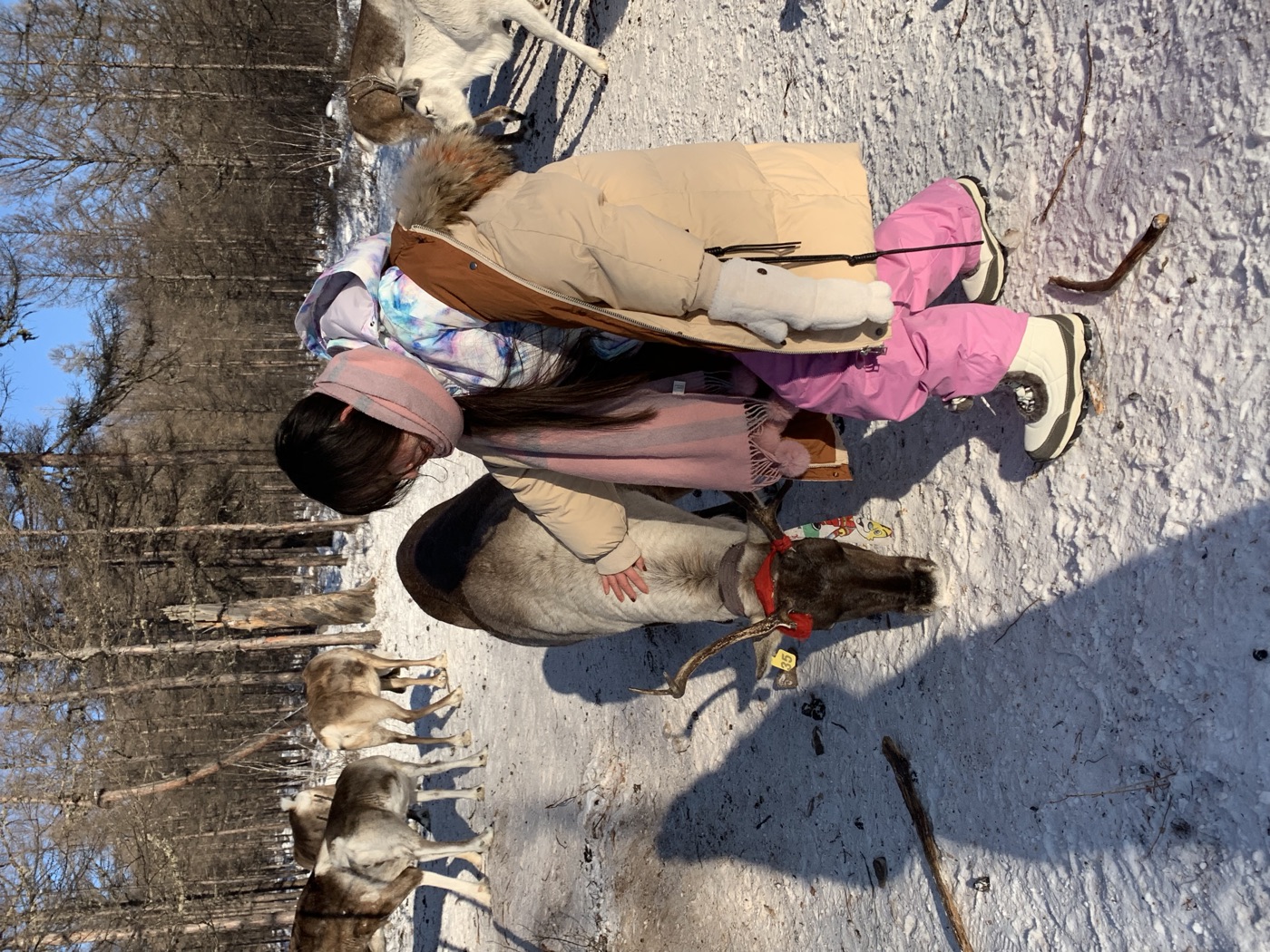
Among the birch trees of Aoluguya: feeding dry lichen to a gentle forest reindeer adorned with a holiday ribbon.
The Boreal Forest: Reindeer of Aoluguya
Driving three hours north from Hailar, the grasslands abruptly surrender to the vast, undulating ridges of the Greater Khingan range. The horizon fills with millions of Siberian larches and white paper birches, their branches heavy with pristine powder. You have entered Genhe, the gateway to Aoluguya (Aoluguya Ewenke).
This is the historic home of China’s last reindeer-herding Evenki clan—a nomadic Tungusic people who lived for centuries deep in the sub-Arctic taiga, migrating alongside their herds, dwelling in cone-shaped birch-bark teepees (Cuoluozi), and practicing shamanic animism.
Visiting in the morning between nine and eleven, when the herd is most alert, is deeply enchanting. For twenty yuan, you purchase a woven wooden basket of dry, brittle reindeer moss (Taixian). The moment you step between the birch trees, gentle, velvet-nosed reindeer begin stepping out from the forest shadows.
Unlike red deer, reindeer are remarkably placid and quiet. Their cloven hooves spread wide on the snow like natural snowshoes, making a soft crunching cadence as they surround you, nudging your mittens and vacuuming the moss from your fingers with surprising gentleness.
Biologically, reindeer are unique: they are the only deer species in the world where both males and females grow antlers. In northern folklore, they are known as the “Four-Not-Likes” (Sibuxiang)—bearing antlers resembling a moose, the head of a horse, the sturdy body of a donkey, and the hooves of a cow.
While the main tourist scenic park offers an informative cultural museum detailing shamanic artifacts and birch-bark craftsmanship, seasoned travelers prefer arranging detours to the smaller, private forestry camps scattered along the logging trails—such as Ayousha or Budongxia. In these uncrowded family clearings, you sit around an outdoor fire with local hunters, drinking tea brewed from wild lingonberry leaves while dozens of reindeer roam unhurried through the trees.
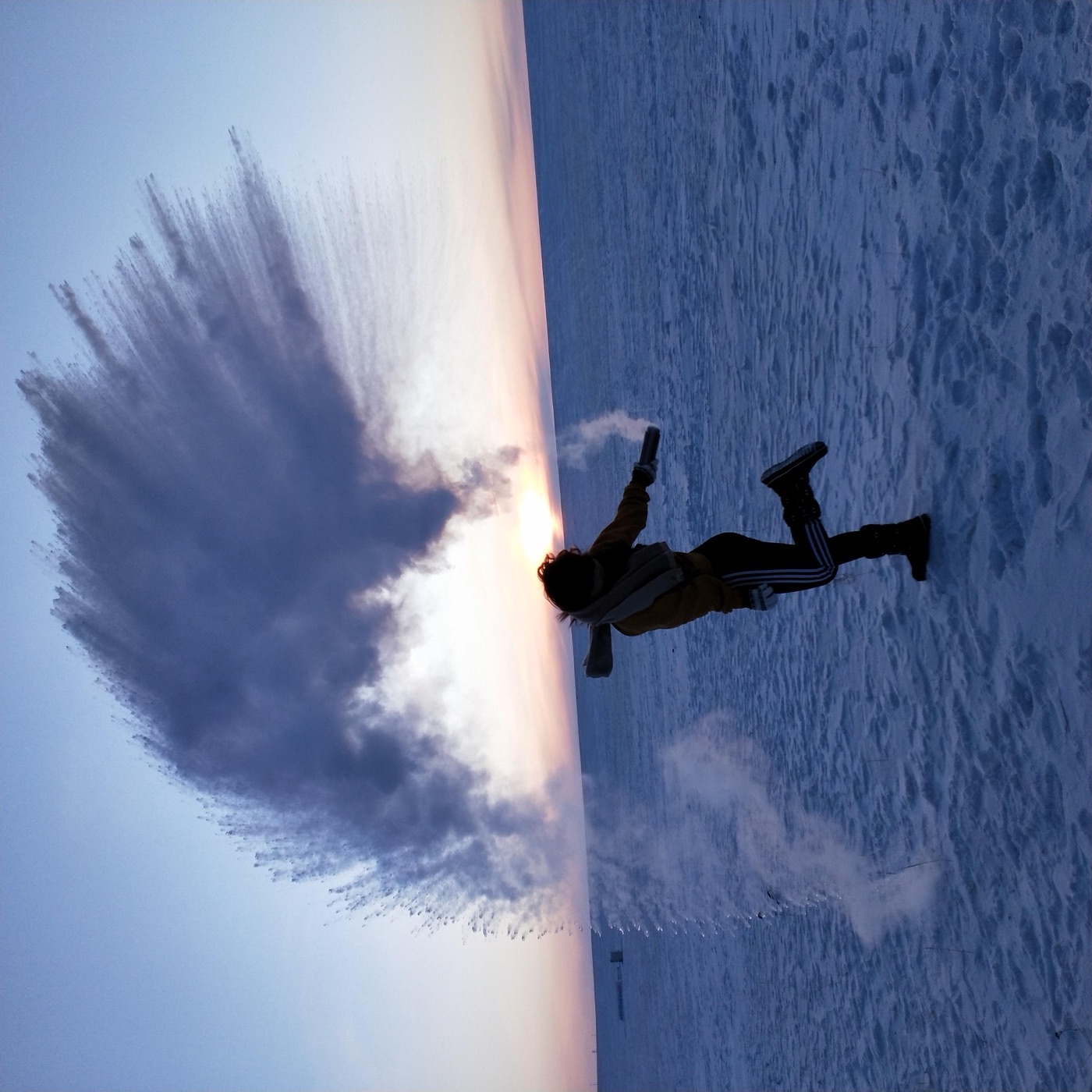
The physics of extreme cold: splashing boiling water at thirty below zero turns instantly into an umbrella of glittering ice crystals.
At China’s Cold Pole: -58°C and Hotpot on a Block of Ice
An hour past Genhe city lies Cold Pole Village (Lengji Cun), an old 1958 state timber logging station formerly known as Jinlin Forestry Farm. In 2009, commercial logging was permanently banned to protect the watershed, and the rustic brick bunkhouses and heated wood-burning platforms (Huokang) were preserved as a winter wonderland.
Genhe carries the certified title of “China’s Cold Pole.” International travelers often assume Mohe—the country’s northernmost county bordering the Amur River—is the coldest spot. In reality, Genhe is significantly colder. Sitting four hundred meters higher in altitude within a deep geological basin surrounded by mountains, dense Siberian cold air pools here like heavy water, unable to escape. Winter temperatures routinely plunge past minus thirty-five degrees, with the folk measuring station once recording a historic minus fifty-eight.
The signature winter ritual here is Poshui Chengbing (泼水成冰)—splashing boiling water into the frozen air. You fill a thermos with water above ninety degrees Celsius, stand in an open, wind-sheltered clearing with the low golden sun at your back, and fling the water backward over your head in a sweeping, continuous arc.
Because of the extreme temperature differential and the Mpemba effect, the scalding water instantly atomizes into microscopic droplets, flash-freezing into thousands of glittering ice crystals that fan out across the twilight sky like the wings of a frozen phoenix, accompanied by a soft, hissing whisper.

Nature’s walk-in freezer: sugar-glazed candied hawthorns cooling upright in the sub-zero snowdrifts of the logging camp.
In this climate, the entire outdoors functions as an infinite deep-freezer. Vendors don’t bother with refrigerators; they simply stick skewers of candied hawthorns (Bingtang Hulu) directly into snowbanks, where the sugar coating turns shatteringly brittle like glass.
Nearby sit trays of Frozen Pears (Dongli)—hard as cannonballs when frozen, but when thawed in a bowl of cold water, their skins turn translucent black and their flesh becomes a slushy, honeyed sorbet that provides heavenly relief after hours inside overheated rooms.
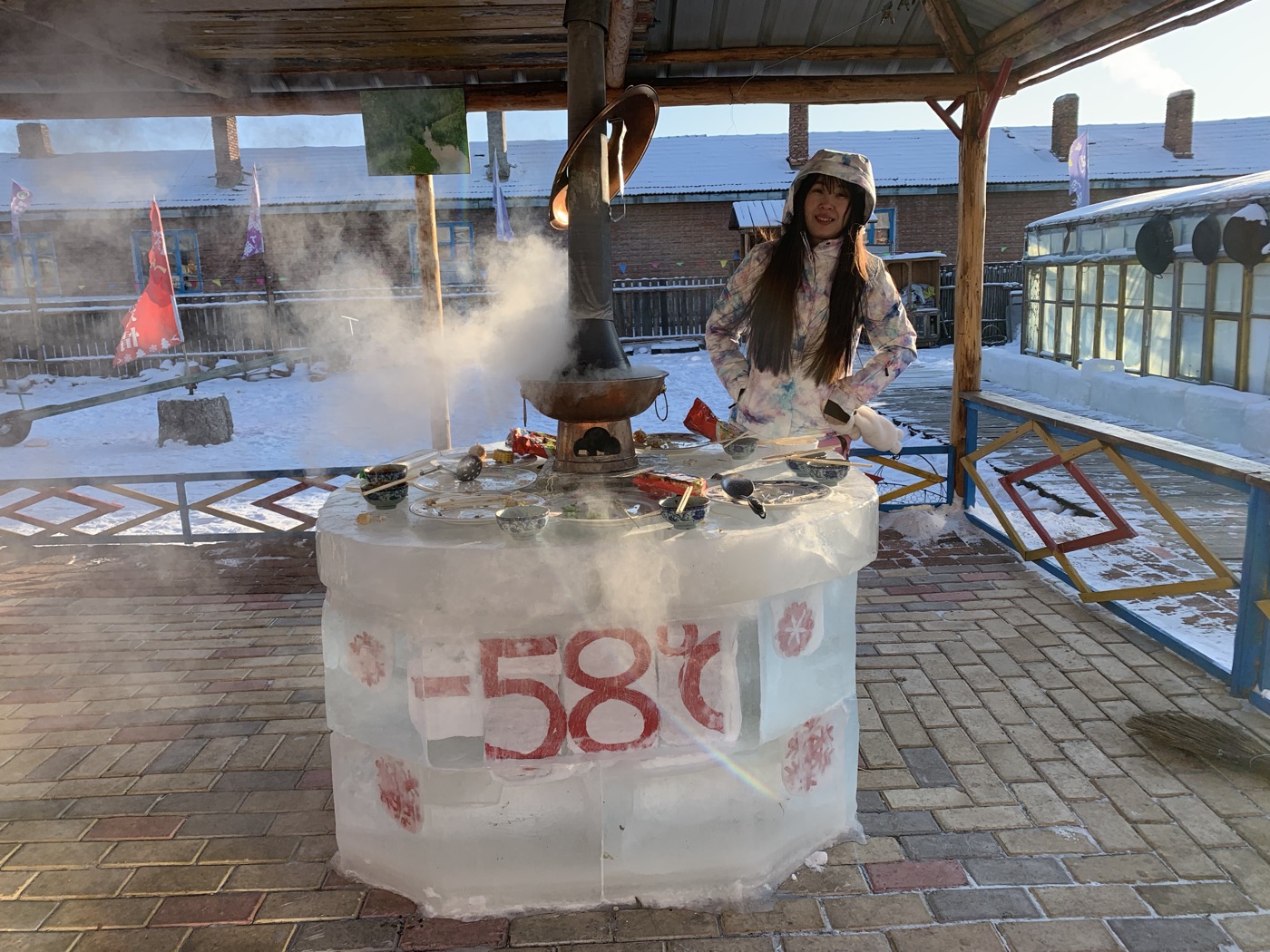
Fire and ice: a boiling charcoal chimney hotpot steaming atop a table sculpted from solid river ice at Cold Pole Village.
Yet nothing prepares you for the surreal spectacle of Cold Pole Village’s outdoor Ice Hotpot. In an open-air timber courtyard, craftsmen carve tables out of massive, crystal-clear blocks of solid river ice, painting the iconic “-58°C” onto their frozen flanks.
You bundle into your parka, sit on wooden chairs cushioned with sheepskin blankets, and gather around a traditional brass chimney hotpot burning red-hot charcoal.
As sub-zero wind whips through the gazebo, the broth bubbles furiously, sending towering plumes of fragrant white steam into the icy air. You drop paper-thin curls of local mutton directly into the bubbling soup, swish them for five seconds, dip them into roasted sesame paste with fermented tofu, and eat before the sauce can freeze on your spoon. The sensory clash between blazing hot soup on your tongue and arctic cold against your cheeks is pure adrenaline.
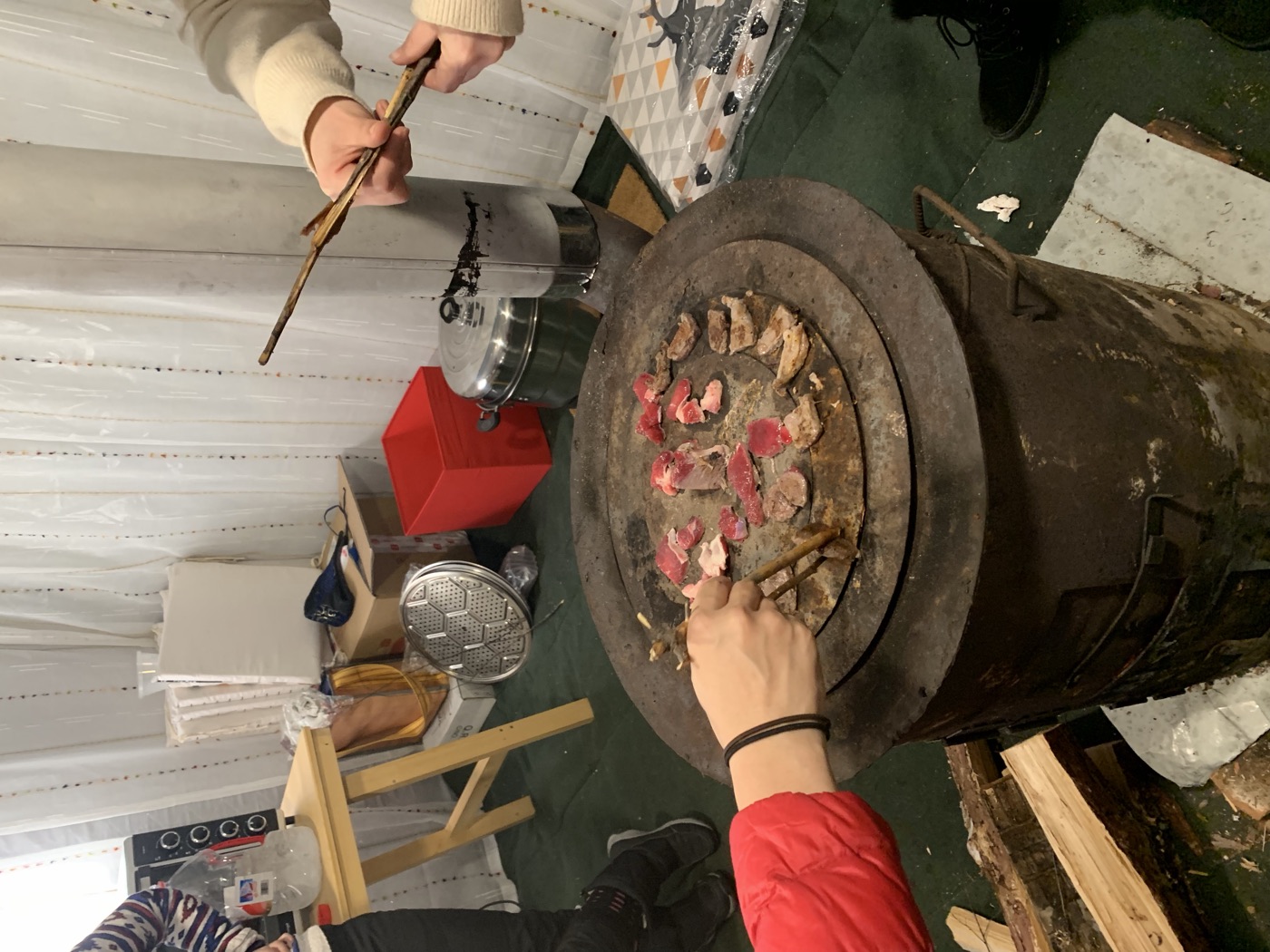
Cabin comfort: grilling fresh mutton slices directly on the scorching cast-iron lid of a wood-burning firewood stove.
For an equally rustic indoor ritual, retreat inside a timber cabin where a cylindrical cast-iron woodstove radiates cozy warmth. The cook rubs the scorchingly hot iron lid of the stove with a piece of lamb fat, laying fresh red slices of mutton directly onto the bare metal. The meat sizzles fiercely, crisping on the outside while locking in rich, woodsmoke-scented juices.

Chiseling through two feet of solid river ice: using a heavy steel ice bar to open a winter fishing hole on the river.
Chiseling the Frozen River: The Art of Ice Fishing
By January, every body of water across Hulunbuir is locked in solid ice up to seventy centimeters thick. On the Hailar River and the vast frozen expanse of Hulun Lake (Hulun Hu), an ancient winter survival tradition takes center stage: ice fishing (Bingdiao).
This is not a casual pastime where you sit in a heated plastic hut with an electric auger. The traditional method demands genuine physical labor.
You stand out on the blinding white ice armed with a heavy steel chisel bar (Bingchuan). Raising the heavy iron rod above your shoulder, you drive it repeatedly into the ice, sending shards flying like broken crystal. It takes twenty minutes of steady, rhythmic striking to chisel a clean, circular cylinder down through the frozen mantle.
Suddenly, with one final strike, the chisel punches through the bottom layer. Dark, unfrozen river water gushes upward under pressure, swirling with slush. You scoop out the floating ice shavings with a perforated shovel, revealing a window into the silent, deep underwater world below.
Drop a weighted line with bait into the dark hole, and within minutes you feel the twitch of wild cold-water fish—such as sweet-fleshed Huazi fish (Amur ide) or sharp-toothed pike (Gouyu). Because the water is near freezing, these fish develop a rich layer of fat beneath their scales, making them exceptionally tender when braised with wild soybean paste over a cabin stove.

Grassroots winter joy: tandem ice-sledding propelled across the natural river ice with spiked hand poles.
While waiting for the fish to bite, locals pull out the traditional wooden and metal ice sleds (Bingche). Sitting low on a steel-runner sled, you grasp two short wooden poles tipped with sharp iron nails, stabbing the ice rhythmically to propel yourself spinning across the natural frozen river rink.
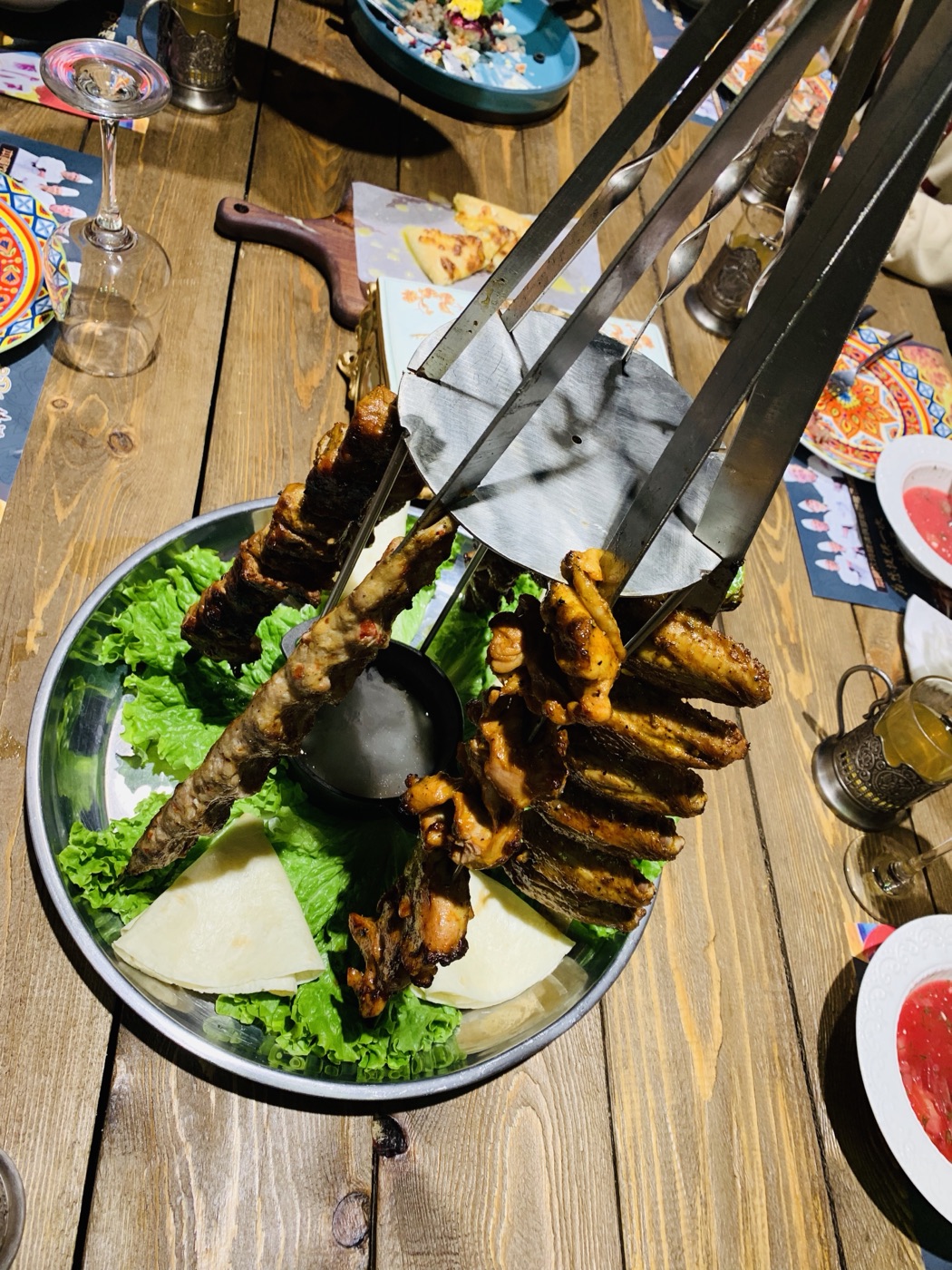
The Siberian border feast: forearm-length Russian shashlik skewers hanging from a tabletop metal carousel.
The Border Banquet: Russian Nights in Manzhouli
At the western terminus of the Hulunbuir circuit sits Manzhouli, a surreal border metropolis where China, Russia, and Mongolia converge.
Emerging from days in the quiet taiga forests into Manzhouli at dusk feels like stepping into a gilded Russian fairy tale. The city’s main boulevards are lined with grand Tsarist-style neoclassical facades, onion domes, and Cyrillic neon signs glowing against the snowy night sky.
Because of more than a century of cross-border trade along the Chinese Eastern Railway, Manzhouli is home to some of the most authentic Russian culinary traditions outside Moscow and Saint Petersburg.

The legendary Lubuli spread: warm golden Nanyang cheese bread, festive layered salad, and tall mugs of cold beer.
The crown jewel of border dining is Lubuli (Lubuli E’canguan). Arrive early or grab a waiting number before nine in the evening, as travelers pack the wood-paneled dining rooms to watch Russian folk dancers and accordions perform on stage.
The essential order begins with Lubuli’s signature Cheese Bread (Nailao Bao). Served piping hot on a wooden cutting board, the golden, hearth-baked bread is filled to bursting with molten, stretchy Russian cheese that pulls in decadent ribbons as you tear it apart with your fingers.
Follow this with a bowl of vibrant Red Borscht (Hongcai Tang), rich with simmered beef brisket, shredded beets, and fresh dill, topped with a generous dollop of tart sour cream.
For the grand finale, servers deliver the vertical Shashlik rack: half-meter-long steel skewers of pork neck and lamb steak roasted over charcoal until crackling on the outside, flanked by flatbreads, raw onions, and tangy tomato adjika sauce. Paired with tall mugs of draft beer or ice-cold Russian vodka, it is the ultimate celebratory feast after days braving the sub-zero wind.
The -30°C Survival Playbook for Foreigners
Surviving and genuinely enjoying the extreme northern winter is entirely a matter of preparation and physics. Keep these hard-earned tactical rules in mind before you pack:
The Three-Layer Rule: Insulation Beats Bulk
Do not wear ten cotton shirts; cotton traps body sweat and turns into a chilling ice blanket the moment you stop moving. Follow the strict technical three-layer principle:
Your base layer must be high-grade moisture-wicking thermal underwear (merino wool or high-end synthetic fibers). Your mid-layer should be a dense fleece pullover or a lightweight packable down sweater that traps dead air. Your outer layer must be a heavy, windproof and water-resistant expedition parka with at least 800-fill down and a minimum 200 grams of fill weight, complete with a fur-trimmed storm hood that shields your cheekbones from biting headwinds.
For your legs, pair thermal leggings with fleece-lined windproof ski pants. Hands and feet lose heat ten times faster than your core: wear two layers of gloves—thin touchscreen liner gloves inside heavy, windproof insulated ski mittens.
The Oversized Boot Rule
Never wear your regular city boots. Buy dedicated high-top, waterproof snow boots at least one size larger than your normal shoe size.
If your boots are tight, your thick socks will compress and your toes will be squeezed, restricting capillary blood circulation and causing frostbite within an hour. The extra size provides room for thick wool socks and adhesive air-activated heating footbeds without restricting blood flow.
Battery Life and the Condensation Trap
Extreme sub-zero cold kills lithium-ion smartphone and camera batteries at terrifying speed. An iPhone at eighty percent charge will often shut down within three minutes if exposed to the open wind.
Keep your phone inside an interior pocket directly against your body heat, and stick an adhesive hand-warmer pad to the back of the case. Keep a portable power bank warm in your inside chest pocket.
More importantly, remember the glass condensation trap. When you step from minus thirty-five degrees outside into a sixty-degree heated restaurant or hotel room, moisture in the warm air will instantly condense onto the freezing glass lenses and circuit boards of your camera and phone, fogging the optics and potentially shorting the electronics.
Before walking through any indoor doorway, place your camera or phone inside a zip-top plastic bag and seal it tightly. Allow the equipment to warm up gradually inside the sealed bag for twenty minutes before opening it.
Transportation: Never Self-Drive on Forest Ice
Unless you possess years of professional experience driving on compacted ice and unplowed forest snow, do not attempt to rent a car and drive yourself across Hulunbuir.
The winter highways often hide treacherous patches of “black ice” beneath powdery snowdrifts, and hundreds of kilometers through the Greater Khingan forests lack mobile cellular signal entirely. If your vehicle spins off the road into a snowbank at night when temperatures hit minus forty, help is hours away.
Instead, hire an experienced local driver with a sturdy four-wheel-drive SUV (typically between six hundred and one thousand yuan per day). Local drivers know how to read the blue ice on frozen river crossings, understand which logging trails remain passable, and can navigate directly to the secret reindeer clearings and sunset hills that standard GPS navigation ignores.
Finally, remember that the sub-Arctic sun sets extraordinarily early in deep winter—often dipping below the horizon by quarter to four in the afternoon. Wake with the dawn, schedule your outdoor river walks and forest hikes between nine in the morning and two in the afternoon, and spend your dark, frost-rimmed evenings where northern nomads have always found joy: gathered closely around a roaring stove with friends, stories, and steaming food.
Curator of China Nomad Guide. Specializing in bespoke route architecture, bilingual on-the-ground fixer services, and neutral medical/dental tourism logistics. Based between Chengdu, Yunnan, and Shanghai.
Get the China Stay China Arrival Kit & Checklist
Don’t get locked out without connectivity or payment at the border. Instant access to our interactive 12-step field guide + offline 1-page PDF printable cheat sheet covering pre-flight eSIMs, foreign card Alipay binding, PSB police registration, and railway ticketing.
Curated by Villanelle (IG: @v.forvillanelle • hello@chinastay.org). Zero spam.