FIELD DISPATCHMention winter travel to most Western globetrotters, and their minds drift toward the powder chalets of Hokkaido or the quiet pine cabins of Lapland. In China, however, the arrival of December triggers an entirely different collective reflex. Across thirty-four provinces, 1.4 billion people look squarely toward the sub-Siberian reaches of Heilongjiang. Even I am packing my thermal base layers and heading north this season. Below is our definitive field guide to the Harbin Ice and Snow World (哈尔滨冰雪大世界): an 800,000-square-meter megalopolis of carved river ice, a real-life answer to Disney’s Frozen that dwarfs any European theme park, and a ground-truth 3-day itinerary through China’s most enchanting winter city.
Key Takeaways (TL;DR)
Domestic travelers fly 3,000 km from Shanghai, Shenzhen, and Chengdu to freeze here. Millions of southern Chinese travelers proudly adopt the badge of Nánfāng Xiǎo Tǔdòu (“Southern Little Potatoes”) in oversized duvet parkas.
At Disneyland Paris or Hong Kong Disneyland, you stand 90 minutes in drizzle for a three-minute animatronic boat ride. Harbin gives you a walk-through glacial kingdom of 250,000 m³ of solid river ice lit from within by millions of LEDs.
Arrive by 2:00 PM to photograph pure diamond-clear ice under blue skies, then watch the synchronized sunset ignition at 4:30 PM when the entire park turns into a glowing cyber-aurora.
Just 4.5 to 5 hours from Beijing aboard the high-speed Fuxing train. Once in town, Harbin Metro Line 2 drops you directly inside the Ice and Snow World ticket plaza.
1. The National Pilgrimage: Why Even Chinese Locals Rush North
There is a widespread misconception among first-time visitors that Harbin’s annual winter spectacle is an export product engineered for international tour groups.
The reality is precisely the opposite: Harbin in January is the ultimate domestic bucket list.
Every December, when the mercury in Harbin sinks toward −25°C (−13°F) and the broad Songhua River freezes into a four-foot-thick sheet of solid structural granite, hundreds of thousands of Chinese travelers who have never seen snow book one-way tickets to the northeast (Dōngběi 东北).
In recent seasons, this migration turned into a full-blown cultural phenomenon. Locals in Heilongjiang affectionately dubbed visiting travelers from Guangdong, Zhejiang, and Sichuan Nánfāng Xiǎo Tǔdòu (南方小土豆, “Southern Little Potatoes”)—a term of endearment for travelers bundled inside ankle-length down coats, fuzzy earmuffs with animal ears, and thermal snow boots, sliding merrily along icy street curbs. In response, Harbin turned on legendary northeastern hospitality: setting up heated roadside rest lounges, deploying indoor drones to assist lost pedestrians, and serving sweet ginger tea on street corners free of charge.
Even seasoned travelers like myself cannot resist the siren song of this subzero theatre. There is something primal and exhilarating about stepping onto a platform in Beijing, boarding a 350 km/h bullet train, and stepping off five hours later into air so crisp it freezes the moisture inside your nostrils in three seconds flat.
2. Elsa’s Ice Palace at Scale: Harbin vs. The Western Theme Park
This year, the Ice and Snow World has incorporated sweeping “Frozen” (冰雪奇缘) aesthetic motifs into its master architecture—and the contrast with Western commercial theme parks could not be more dramatic.
If you have ever visited Disneyland Paris (Walt Disney Studios Park) or Hong Kong Disneyland’s World of Frozen, you know the grueling formula:
- You wake up at dawn to secure a virtual queue slot.
- You stand in an eighty-to-ninety-minute cattle-chute line in cold winter drizzle.
- You board a three-minute water coaster that glides past plastic animatronics and synthetic snow spray.
- You exit directly into a gift shop selling €35 plush reindeer.
“At Disney, you pay hundreds of dollars to look at fiberglass sprayed with artificial polymer snow. In Harbin, you are walking inside an actual glacier harvested by chain-saw from a Siberian river.”
Harbin’s Ice and Snow World operates on the scale of an imperial civilization:
Every single block of ice is quarried by teams of local rivermen from the Songhua River in early December. Using massive hand saws and hydraulic cranes, they haul meter-thick slabs of flawless crystalline freshwater ice onto flatbed trucks. Within fifteen days, over 10,000 master sculptors and civil engineers carve these raw blocks into 40-meter-tall Gothic steeples, Russian Baroque palaces, towering Chinese dynastic pagodas, and sweeping spiral staircases.
Yes, there are queues in Harbin—most notably for the Super Ice Slide (超级大滑梯), where you rocket down a half-kilometer chute of polished ice on a plastic sled, or the heated food court pavilions. But unlike the enclosed queues of Western amusement parks, Harbin is an open, walkable landscape. You can spend four hours simply wandering through colossal ice colonnades, watching light refract through crystal walls, and marveling at architecture that will melt completely back into the river by March.
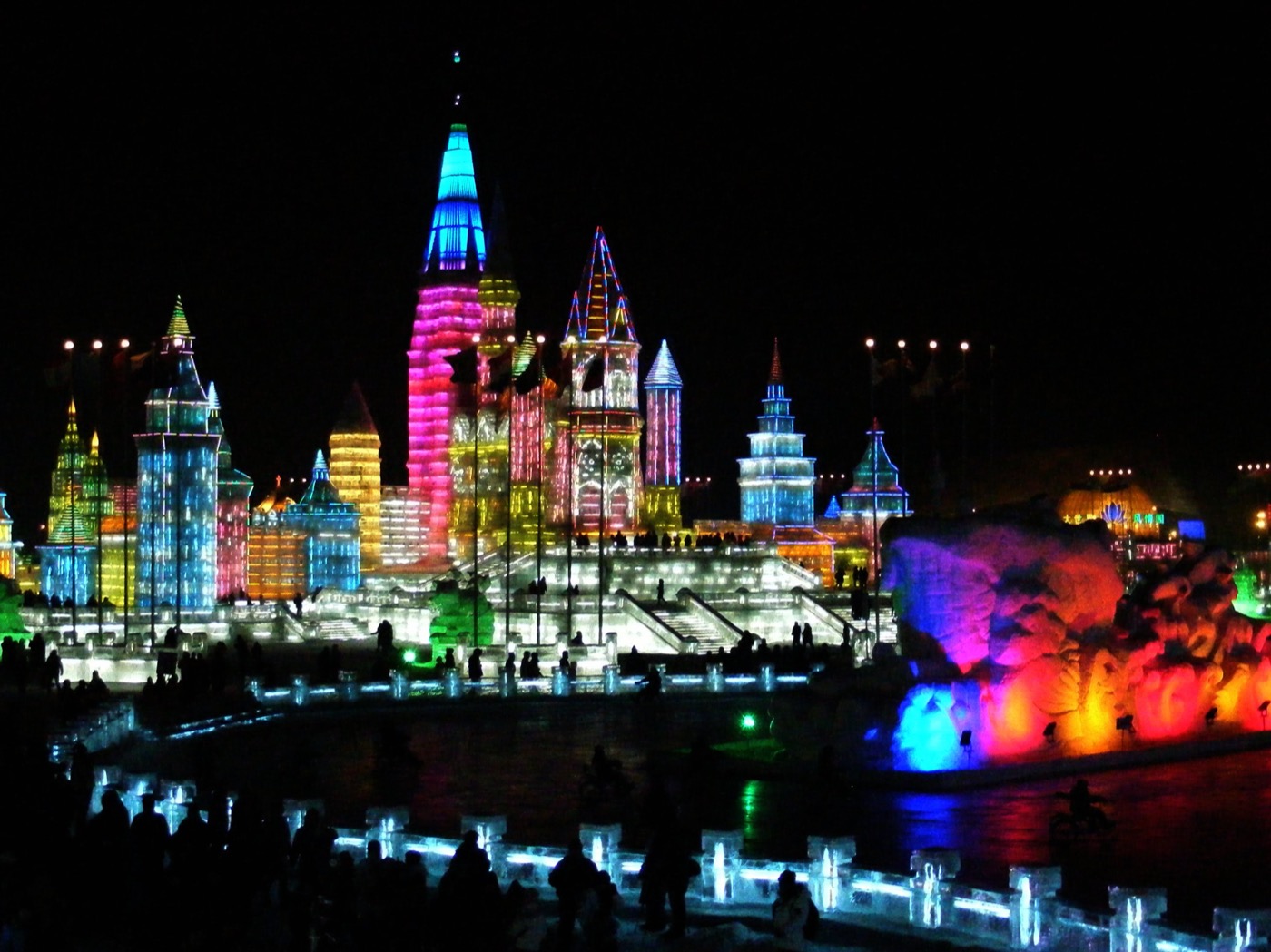
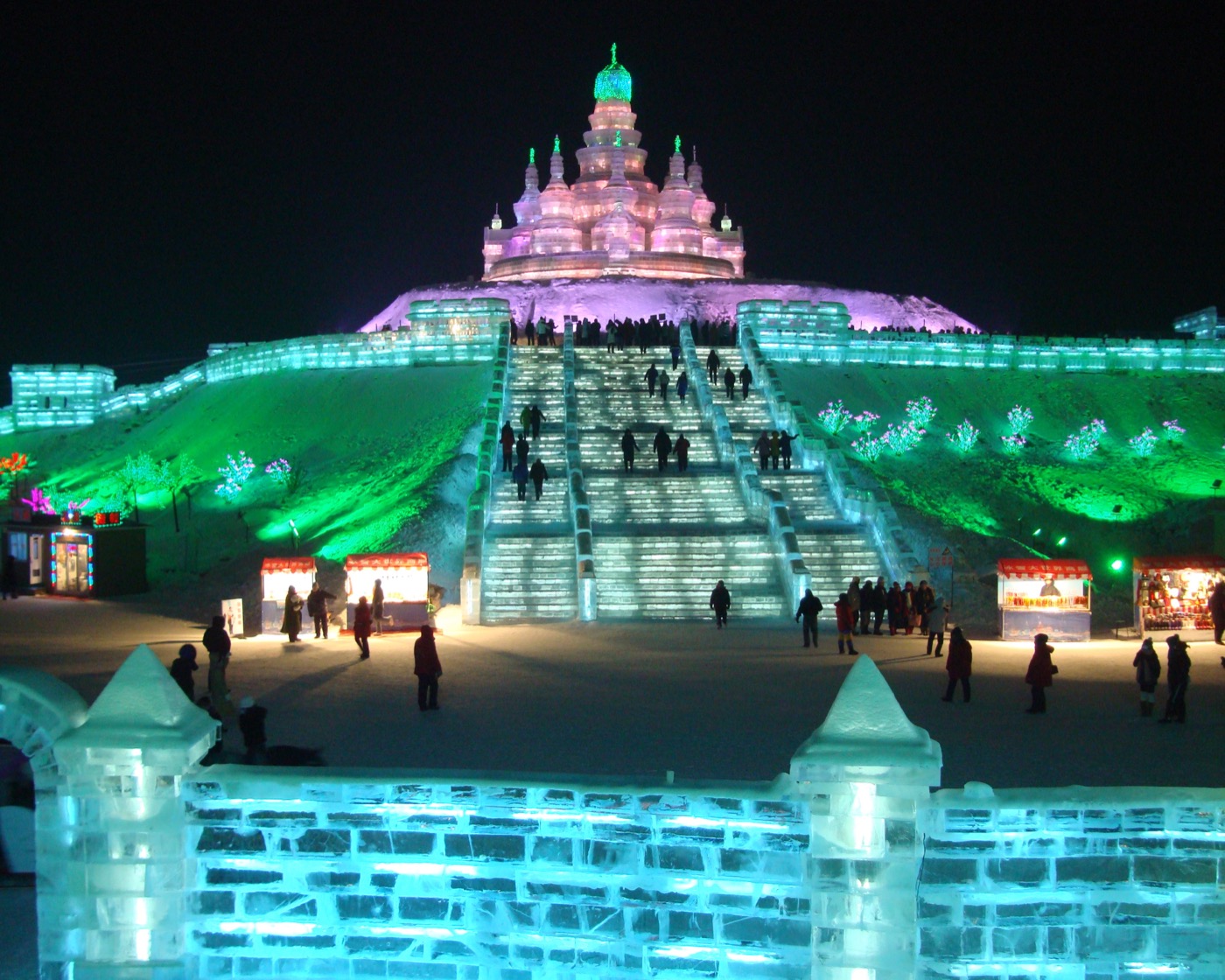
Twilight over the ice city: The delicate 30-minute transition when natural cobalt dusk meets the electric ignition of LED lamps embedded inside the ice walls. (Source: Wikimedia Commons, CC BY-SA 2.0)
3. The 3-Day Harbin Field Guide: An Authentic Winter Itinerary
Most travel blogs treat Harbin as a quick 24-hour sprint to the ice park. That is a mistake. Harbin is one of China’s most culturally unusual provincial capitals—a former Russian-administered railway boomtown where Orthodox onion domes, Art Nouveau cornices, and spicy Dongbei barbecue coexist in subzero harmony.
Here is the exact three-day itinerary to experience the city at its peak.
Tsarist Echoes, Byzantine Bricks & The Subzero Popsicle
09:30 AM — Saint Sophia Cathedral (圣索菲亚大教堂): Begin your morning at Harbin’s most famous landmark. Built in 1907 as an Orthodox garrison church for the Russian Empire’s Trans-Siberian Railway expansion, its monumental dark-green onion dome and Byzantine red-brick facade look extraordinary against falling snow. Watch flocks of white pigeons whirl through the morning mist. Inside, the deconsecrated hall houses an evocative photographic archive of Harbin’s 1920s Russian emigré community.
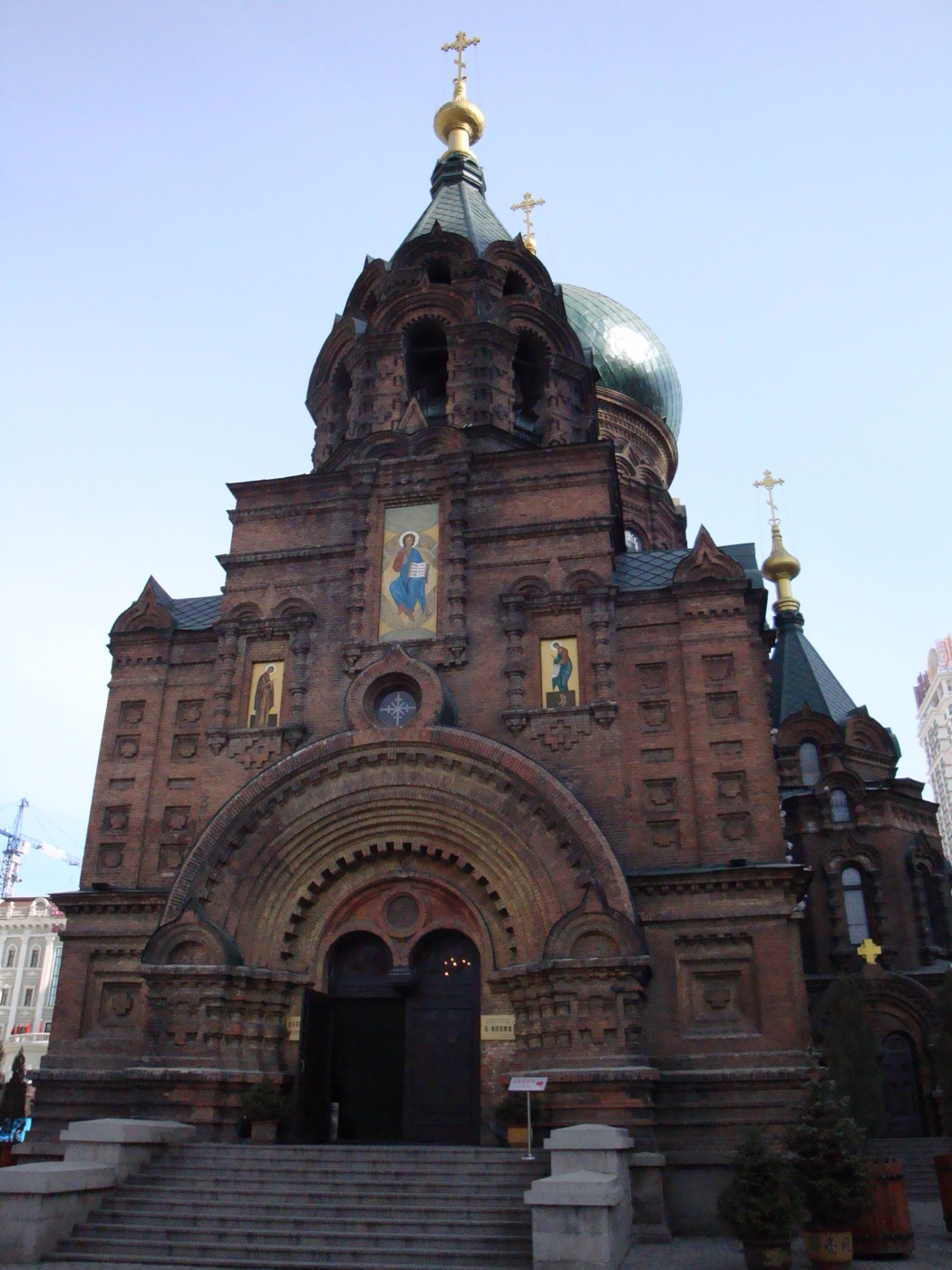
Saint Sophia Cathedral: Russian neo-Byzantine architecture in the heart of Manchuria. (Source: Wikimedia Commons, CC BY-SA 3.0)
01:00 PM — The Russian Cobblestones of Zhongyang Street (中央大街): Stroll along the premier pedestrian promenade of the northeast. Paved in 1924 with rounded granite blocks rumored to have cost one silver ruble apiece, this 1.4-kilometer avenue is lined with Renaissance, Baroque, and Eclecticist storefronts.
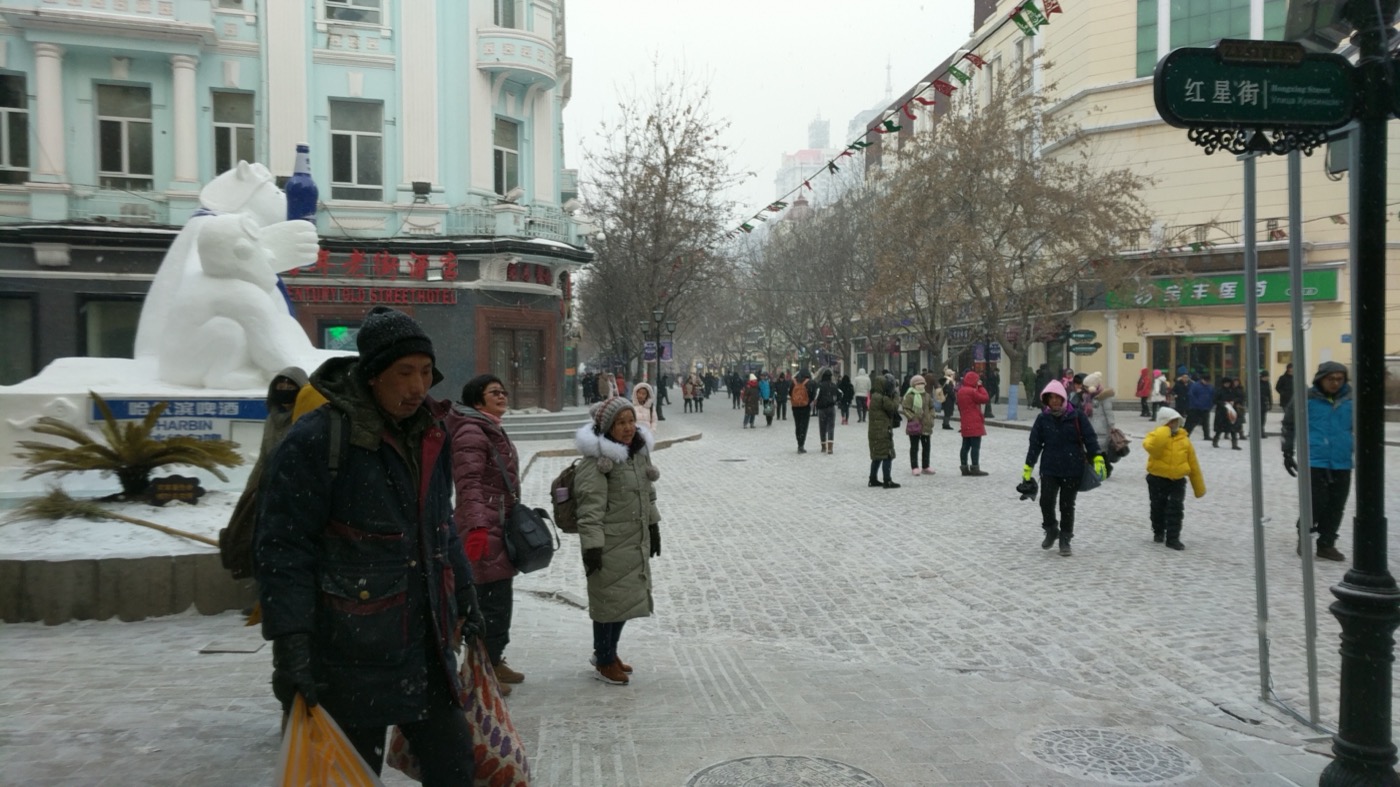
Zhongyang Dajie (Central Street): Historic European architecture preserved along Harbin’s flagship winter avenue. (Source: Wikimedia Commons, CC BY-SA 3.0)
The Street Food Rite of Passage: Madieer Popsicles (马迭尔冰棍): Outside the historic 1906 Modern Hotel, join the crowd eating vanilla ice cream bars at −20°C. In Harbin, ice cream vendors do not use freezers; they stack cardboard boxes directly on the sidewalk because the outdoor air is colder than any freezer. Eating rich, sweet dairy while your breath billows in clouds of steam is mandatory.
06:00 PM — Classical Russian-Manchurian Dinner: Dine at Tatoc (塔道斯) or Luoxiya Cafe (露西亚咖啡西餐厅). Order traditional borscht (luósòng tāng), Russian braised pot beef (guàn niúròu), smoked Harbin red sausage (hóngcháng), and sourdough rye bread (dàlièba 大列巴) with cold farm butter.
The Glacial Kingdom: Mastering the Ice and Snow World
10:00 AM — Morning Slumber & Heavy Fueling: Conserve your stamina. Wandering an outdoor ice plain at subzero temperatures burns calories at triple your normal metabolic rate. Eat a robust hot breakfast of Dongbei dumplings (shuǐjiǎo) or hot beef noodle soup.
01:30 PM — Metro Line 2 to Ice & Snow World: Board Harbin Metro Line 2 directly to Ice and Snow World Station (冰雪大世界站). Exit directly into the ticketing plaza. Pro Tip: Arriving between 1:30 PM and 2:00 PM is the master move. You enter before the tour bus rush, and you experience the ice sculptures in their pure, natural state: transparent, crystalline, and sparkling like quartz under the stark Arctic sun.
04:15–04:45 PM — The Synchronized Sunset Ignition: Position yourself near the central spire. As the sun sinks below the flat western horizon, a single switch illuminates hundreds of thousands of LED channels encased inside the ice. The entire landscape erupts from pale glacial blue into a radioactive wonderland of fuchsia, electric turquoise, royal gold, and ultraviolet.
05:30 PM — Thermal Survival Strategy: Adopt the “30 on, 15 off” cycle. Walk the outdoor terraces for thirty minutes, then step into one of the heated service domes for a cup of steaming hot spiced pear tea (rè lí tāng) or candied hawthorn skewers (bīngtánghúlu). Never let your toes go numb.
The Frozen River, Snow Giants & China-Baroque Flavors
10:00 AM — Walking Across the Songhua River (松花江): Walk down to Flood Control Monument. The wide Songhua River is frozen so hard that trucks and hovercrafts drive across it. Rent an ice sled (a miniature wooden bench with two handheld spikes) or simply hike across the ice sheets. Along the northern bank, watch members of the legendary Harbin Winter Swimming Club (哈尔滨冬泳队)—mostly fearless men and women in their sixties and seventies—do calisthenics in swimsuits before diving into a pool of black river water cut directly into the ice.
12:30 PM — Sun Island International Snow Sculpture Expo (太阳岛雪博会): Unlike the translucent river ice of the night park, Sun Island is dedicated to monumental compressed snow. International artists carve multi-story snow cliffs into mythical creatures, classical European allegories, and colossal human portraits that look like marble temples carved out of Arctic clouds.
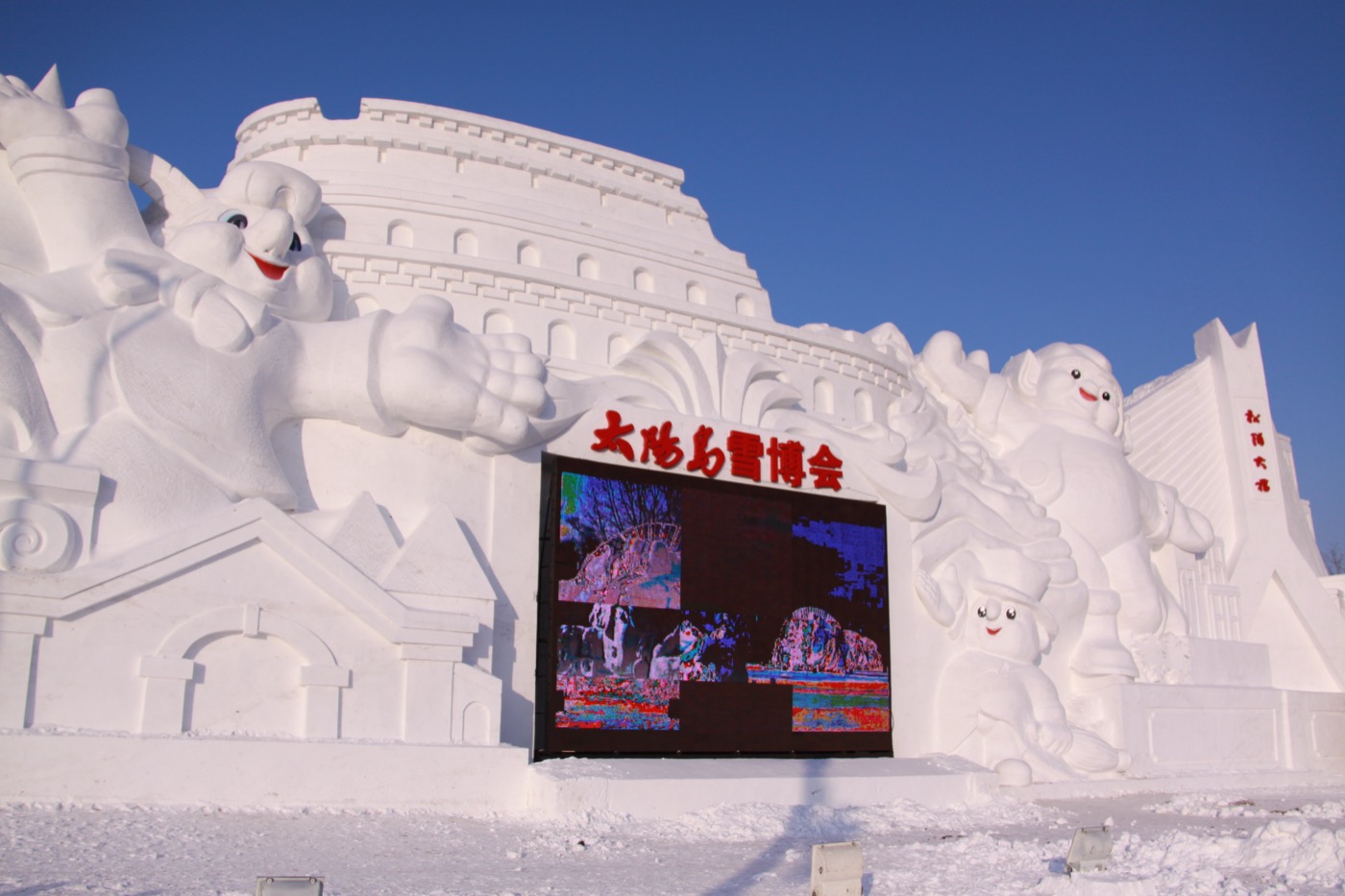
Sun Island Snow Expo: Massive architectural carvings crafted entirely from densely packed pristine snow. (Source: Wikimedia Commons, CC BY-SA 3.0)
04:30 PM — Chinese Baroque Quarter in Daowai (中华巴洛克): End your journey in Harbin’s oldest commercial district. In the 1910s, wealthy Chinese merchants copied European Baroque facades on the street front, but built traditional Chinese courtyard courtyards behind them. Today, the restored alleys are filled with steam, lanterns, and antique wooden storefronts.
Farewell Feast: Guobaorou at Lao Chujia (老厨家): You cannot leave Harbin without eating authentic Guobaorou (锅包肉)—crispy double-fried pork cutlets glazed in sweet vinegar, ginger, and scallions. Lao Chujia’s founder invented this dish in 1907 for the chief Russian rail engineers who found traditional northeastern cuisine too salty. Accompanied by a frosty bottle of Harbin 1900 Beer, it is the greatest culinary comfort in the Chinese north.
4. The Subzero Survival Playbook: Equipment & Logistics
Navigating −25°C requires respect for physics. A casual vacationer wearing city sneakers and a fashion coat will find themselves stranded inside a heated Starbucks within twenty minutes.
Lithium-ion phone batteries drop from 85% to 0% in under three minutes when exposed to −20°C wind. Buy disposable self-adhesive body warmers (nuǎntiē 暖贴) at any corner store and stick one directly to the back of your phone case.
Base layer: Merino wool or moisture-wicking synthetic thermal underwear. Mid layer: Heavy fleece or lightweight down jacket. Outer layer: Knee-length, windproof, hooded down parka (at least 700+ fill power). Wear ski pants over thermal leggings.
Cold enters from the pavement. Wear waterproof boots with thick rubber tread (ice slip-on cleats cost ¥15 on street corners) and wool insoles. Caution: Metal eyeglass frames will freeze to facial skin; switch to plastic frames or contact lenses.
Getting to Harbin
- By High-Speed Train: High-speed Fuxing bullet trains run frequently from Beijing Chaoyang and Beijing South to Harbin West Station (哈尔滨西站) in just 4.5 to 5 hours. Learn how to secure your seats in our comprehensive China High-Speed Train Booking Guide.
- By Air: Harbin Taiping International Airport (HRB) connects via direct domestic flights to Shanghai, Guangzhou, Shenzhen, and international hubs like Tokyo, Seoul, and Singapore.
- Local Payments: Cash is virtually nonexistent. Set up your mobile payment accounts in advance with our Foreigner’s Guide to Alipay and WeChat Pay.
- Mobile Connectivity & VPNs: Ensure you have reliable uncensored data before boarding with our China VPN & Internet Survival Guide.
Need dinner inspiration right off the freezing avenue? Track down a whistling charcoal cart serving Harbin Grilled Cold Noodles (Kao Lengmian) — or practice brushing fermented bean paste, cracking an egg over pressed noodle sheets, and timing the charcoal flip in our free browser mini-game Street Food Legends: Harbin Kao Lengmian.
Combine Harbin with China’s Wildest Arctic Steppe
If you crave an even more remote, wild frontier after experiencing Harbin’s neon ice metropolis, continue further northwest into the frozen taiga. Read our acclaimed dispatch on Hailar & China’s Frozen Pole: Reindeer, Ice Hotpot & The Great Siberian Edge to encounter wild Arctic reindeer and nomadic horsemen on the Hulunbuir steppe.
Need private licensed transport, VIP queue facilitation, or a bespoke multi-province winter itinerary arranged through our private travel collective? Explore our Tailored Travel Planning Service or write to us at hello@chinastay.org.
Curator of China Nomad Guide. Specializing in bespoke route architecture, bilingual on-the-ground fixer services, and neutral medical/dental tourism logistics. Based between Chengdu, Yunnan, and Shanghai.
Get the China Stay China Arrival Kit & Checklist
Don’t get locked out without connectivity or payment at the border. Instant access to our interactive 12-step field guide + offline 1-page PDF printable cheat sheet covering pre-flight eSIMs, foreign card Alipay binding, PSB police registration, and railway ticketing.
Curated by Villanelle (IG: @v.forvillanelle • hello@chinastay.org). Zero spam.