FIELD DISPATCHJust 24 minutes out of Wuhan aboard a 300 km/h bullet train, the mega-city skyline of central China dissolves into misty, water-laced plains and low limestone ridges. Two unassuming neighboring counties here—Anlu and Yunmeng—carry the deepest ghost water in Chinese history: the mythical, vanished inland sea of Yunmengze (云梦泽)—literally translated as “The Marsh of Cloud and Dream.” Long after 40,000 square kilometers of prehistoric marshland dried into farmland, the damp earth beneath the water table kept a secret diary of the empire. Below is our literary field guide to ancient China’s most relatable corporate clerk, two Qin conscript brothers begging their mother for winter clothes, and the ten drunken years Li Bai spent hiding in these hills.
Key Takeaways (TL;DR)
- The Phantom Water: Classical Chinese poetry treats Yunmengze (云梦泽)—poetically named the “Cloud Dream Marsh” (云 yún, cloud; 梦 mèng, dream; 泽 zé, marshland)—as an ethereal, fog-wrapped realm of river gods and mythical beasts. In reality, it was a staggering 40,000-square-kilometer freshwater marshland that silted over across millennia. In 550 CE, Western Wei bureaucrats literally chopped the character ze (沼泽, marsh) off the name and founded Yunmeng County—because the water had receded beneath their sandals.
- The 2,180-Year-Old Google Calendar: In 2006, archaeologists excavated the tomb of Clerk Yueren (越人) in Yunmeng. Sealed in waterlogged, airtight clay were 14 years of bamboo daily planners (170–157 BCE). The verdict? Fifteen years on the job, zero promotions, endless administrative errands, and an entry where his father passes away and Yueren reports back to his desk on Day 11. No bereavement leave in the Western Han empire.
- The Oldest Family Letter in China: Just 70 meters away in Shuihudi lies the resting place of Qin soldiers Hei Fu and Jing. Inscribed on thin wooden boards from 223 BCE are the oldest personal letters ever recovered in China: two young conscripts writing home from the front lines, asking their mother if she can spare money and send winter clothing before the frost sets in.
- Li Bai’s Lost Decade: Everyone knows Li Bai drinking in Chang’an taverns or sailing down the Three Gorges. Almost no one knows that between ages 27 and 37, he moved to Mount Baizhao in Anlu, married the granddaughter of a retired Tang chancellor, and spent ten years drinking wine in pine huts while writing job applications that name-dropped the wild marshland.
- How to Visit (24 Mins from Wuhan): Both towns sit directly on the Wuhan–Shiyan High-Speed Railway. You can explore the world-class Yunmeng County Museum (free, passport-friendly) in the morning, hike Li Bai’s mountain hermitage in the afternoon, and walk through thousands of golden ginkgoes at Qianchong Valley in late November.
1. The Phantom Water of the Empire
Ask an educated Chinese traveler where to find Yunmengze (云梦泽), and they will likely recite a verse from the Shijing or Sima Xiangru’s grand Chu rhapsodies, imagining a shimmering, boundless expanse where mythical deer roamed through five-meter reeds and dragon boats skimmed across endless mist.
If you pull out a modern satellite map of Hubei, however, you will search in vain for a lake by that name.
Historical geographers have established that at its geographic zenith during the first millennium BCE, Yunmengze was not a metaphor. It was an enormous, labyrinthine inland delta and wetland ecosystem covering more than 40,000 square kilometers across the Jianghan Plain—stretching across what is today Jingzhou, Qianjiang, Tianmen, and Xiaogan. Over centuries, the sediment carried down from the upper Yangtze and Han Rivers settled into the basin. The water level dropped; shallow lakes fragmented into lagoons; the lagoons hardened into black, loamy silt. Today, that vast inland sea survives only as the reason Hubei bears the proud nickname The Province of a Thousand Lakes (千湖之省).
Yet if you follow the paper trail of ancient cartographers, two small towns stand out like lighthouses left on a vanished shore: Anlu (安陆) and its neighboring little sibling, Yunmeng (云梦).
The Tang dynasty geographic treatise Kuodizhi (括地志) gave travelers an exact bearing:
“The Marsh of Yunmeng lies fifty li southeast of Anlu County in Anzhou.”
Three centuries earlier, in 550 CE, administrators of the Western Wei dynasty decided to carve out a new administrative district from Anlu. Looking out over the dry paddies where water once lapped at the reeds, they performed an act of bureaucratic dry wit: they took the three characters Yun-Meng-Ze (云梦泽), dropped the character Ze (泽, meaning marsh or wetland), and christened the newly minted town Yunmeng County (云梦县).
The lake was gone, but the name stuck to the soil. Two thousand years after the tides receded, the damp earth continues to give up two entirely different forms of human warmth: the poetry of a drunk genius in the hills, and the handwritten grievances of civil servants in the mud.
2. Clerk Yueren and the 2,180-Year-Old Google Calendar
In late 2006, construction workers and archaeologists in Yunmeng County dug into an unassuming burial mound labeled Tomb M77. Unlike the dramatic dry deserts of Dunhuang or Xinjiang where silks survive through arid desiccation, central Hubei is damp and humid. Wood usually rots away within a century.
What saved Tomb M77 was pure geological circumstance. The tomb lay squarely beneath the natural water table, tightly sealed under thick, oxygen-deprived green-gray clay. The coffin had flooded almost immediately after burial, creating a sterile, anaerobic water chamber.
Inside rested an obscure junior civil servant named Yueren (越人), buried around 157 BCE during the reign of Emperor Wen of Han. Placed beside his bones was something that had never before survived in the archaeological record of the Western Han dynasty: fourteen annual sets of bamboo appointment diaries, known as Zhiri (质日).
Think of it as a bound, physical Google Calendar running continuously from 170 BCE to 157 BCE.
The 14-Year Daily Planner of Clerk Yueren (越人质日)
Fourteen bound sets of bamboo almanacs detailing the exhausting, unglamorous daily routine of an unranked county civil servant—logging horse purchases, river dikes, corvée labor escorts, and 20-day treks across Hubei with zero promotions over fifteen years.
For over a decade, paleographers at the Hubei Provincial Institute of Cultural Relics and Archaeology painstakingly restored and transcribed more than 1,700 shattered bamboo splints. The definitive monograph was published only recently in 2024—and what emerged was not a heroic chronicle of generals, but the exhausting, mundane, oddly hilarious daily grind of a junior office worker.
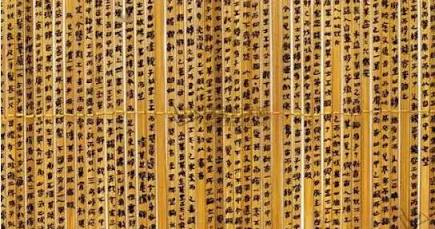 Daily entries inscribed in ink on bamboo slips: Clerk Yueren’s ancient appointment calendar recovered from Tomb M77. (Source: Xinhua / 新华网)
Yueren was an errand runner for the county magistrate. His bamboo calendars are crowded with brief, tidy notes in clerical script (lishu):
- “Fourth month, day of Dingyou: Traveled to Anlu to inspect the stables and buy military horses.”
- “Sixth month, day of Gengchen: Escorted thirty conscript laborers to the river dyke; rain held off until dusk.”
- “Eighth month: Delivered the regional tax ledgers to the commandery headquarters. Twenty-one days on the road.”
For fifteen consecutive years, Yueren logged his tasks. He audited granaries, mediated water disputes between peasants, and walked the muddy relay roads between Hubei counties. And in fifteen years of relentless administrative labor, his rank never moved an inch. He entered public service as an unranked junior scribe, and he went into the damp earth as an unranked junior scribe.
The 20-Character Gut Punch
Yet tucked among the dry records of grain quotas and mule purchases is a five-line sequence that stops modern readers in their tracks. It contains just twenty Chinese characters, stripped of literary flourish, theatrical melodrama, or self-pity:
Day 1: Father falls critically ill upon his woven mat.
Day 4: Yueren rushes back from an official errand.
Day 10: Father is buried in the hillside.
Day 11: Yueren reports back to his desk.
There was no bereavement leave in the administrative handbook of the Western Han dynasty. On the eleventh morning, the ink stone was ground, the brushes were unrolled, and Yueren was back at his low wooden table auditing seasonal barley quotas while the dirt on his father’s mound was still moist.
The Career Peak: A Ticket on the Imperial Relay Chariot
Lest you imagine Yueren’s life was pure misery, the bamboo slips reveal one incandescent week where he touched the summit of the known world.
Under imperial Han sumptuary law, junior clerks were strictly forbidden from boarding official state carriages; they walked on foot or rode draught mules. But on two extraordinary occasions, Yueren received an imperial transit pass authorizing him to ride the chengzhuan (乘传)—the high-speed relay chariot network reserved for urgent imperial couriers and ambassadors.
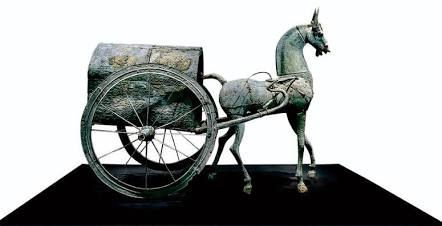 Imperial speed: Official Han Dynasty bronze chariot and horses. Junior clerks like Yueren were normally barred from carriages, making his 5-day express run to Chang’an the pinnacle of his career. (Source: China Daily)
Riding express horses through the relay post stations, Yueren raced from the wetlands of Hubei through the Wu Pass and into the imperial capital of Chang’an in just five blistering days to deliver an official tribute ledger.
He stayed in the gleaming metropolis for nine days—gazing at the soaring timber towers of Weiyang Palace, drinking northern grain spirits, and walking streets wide enough for twelve wagons abreast. When he finally returned down the southern road to his sleepy county office, the magistrate granted him twelve full days of compensatory rest. For a low-ranking county scribe who spent his life measuring hemp and millet, it was the triumph of a lifetime.
3. “Mom, Please Send Cash and Clothes” — The Soldier in the Clay
If Clerk Yueren’s daily planner sounds like a miracle of preservation, cross the courtyard at the cemetery site. Just seventy meters away lies an even earlier cemetery: Shuihudi (睡虎地).
In the winter of 1975, local villagers digging an irrigation drainage canal struck timber planking beneath the clay. Archaeologists arrived to uncover Tomb 11, the burial of a Qin dynasty legal clerk named Xi (喜), who died in 217 BCE—just four years after Qin Shi Huang unified the empire.
Surrounding Xi’s skeleton were 1,155 bamboo slips, containing the most comprehensive administrative handbook of the early Chinese empire ever found: laws dictating how many days a courier had to cover a mountain pass, exact financial penalties for allowing county draft cattle to lose weight, and court instructions on forensic crime scene examinations.
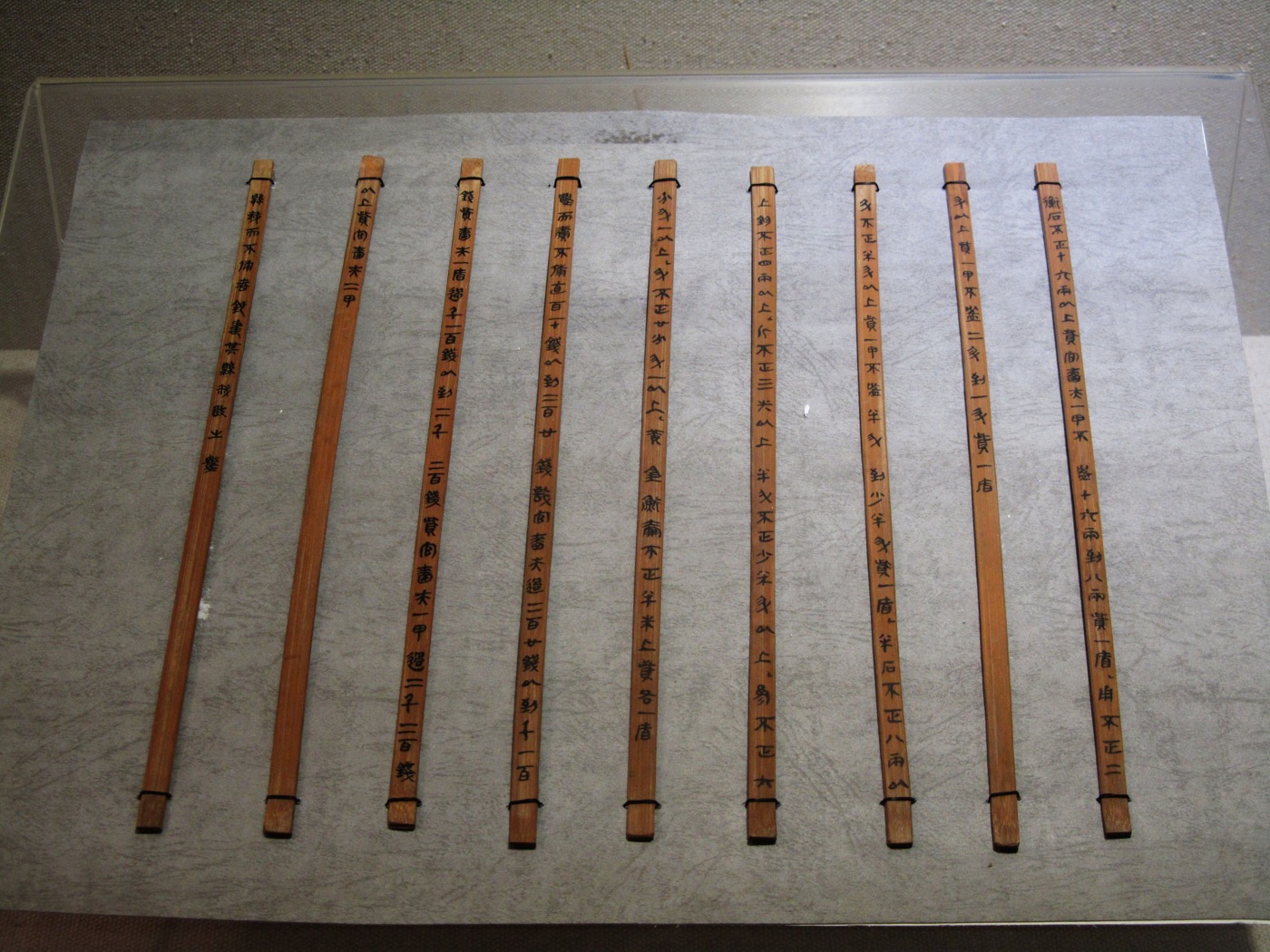
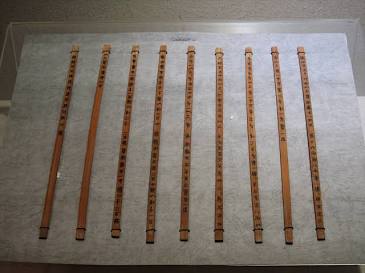 The legal bedrock of the first empire: 2,200-year-old Qin Dynasty bamboo slips unearthed at Shuihudi, Yunmeng. (Source: Wikipedia)
Even more moving than Xi’s law books are two rectangular wooden boards (mudu) unearthed from nearby Tomb 4. They are the earliest known personal letters in Chinese history, dating to 223 BCE, when the Qin army was waging its final, brutal campaign to conquer the southern Kingdom of Chu.
The Conscript Letters of Hei Fu & Jing (黑夫与惊木牍家书)
“Hei Fu and Jing bow their heads to ask after Mother. Are you well? Since we parted, we have stayed alive together… Summer is coming and we have no summer clothing. If Mother has surplus cash, please send us both summer clothes and coins. If the price of homespun hemp is too high in the market, please send the money directly, and we will purchase linen here to sew tunics ourselves before the campaign begins…”
The authors were two peasant brothers named Hei Fu (黑夫) and Jing (惊), conscripted into the Qin infantry. Writing brush-to-wood to their elder brother Zhong (衷) and their aging mother back home in Anlu, their message cuts through two millennia of imperial propaganda.
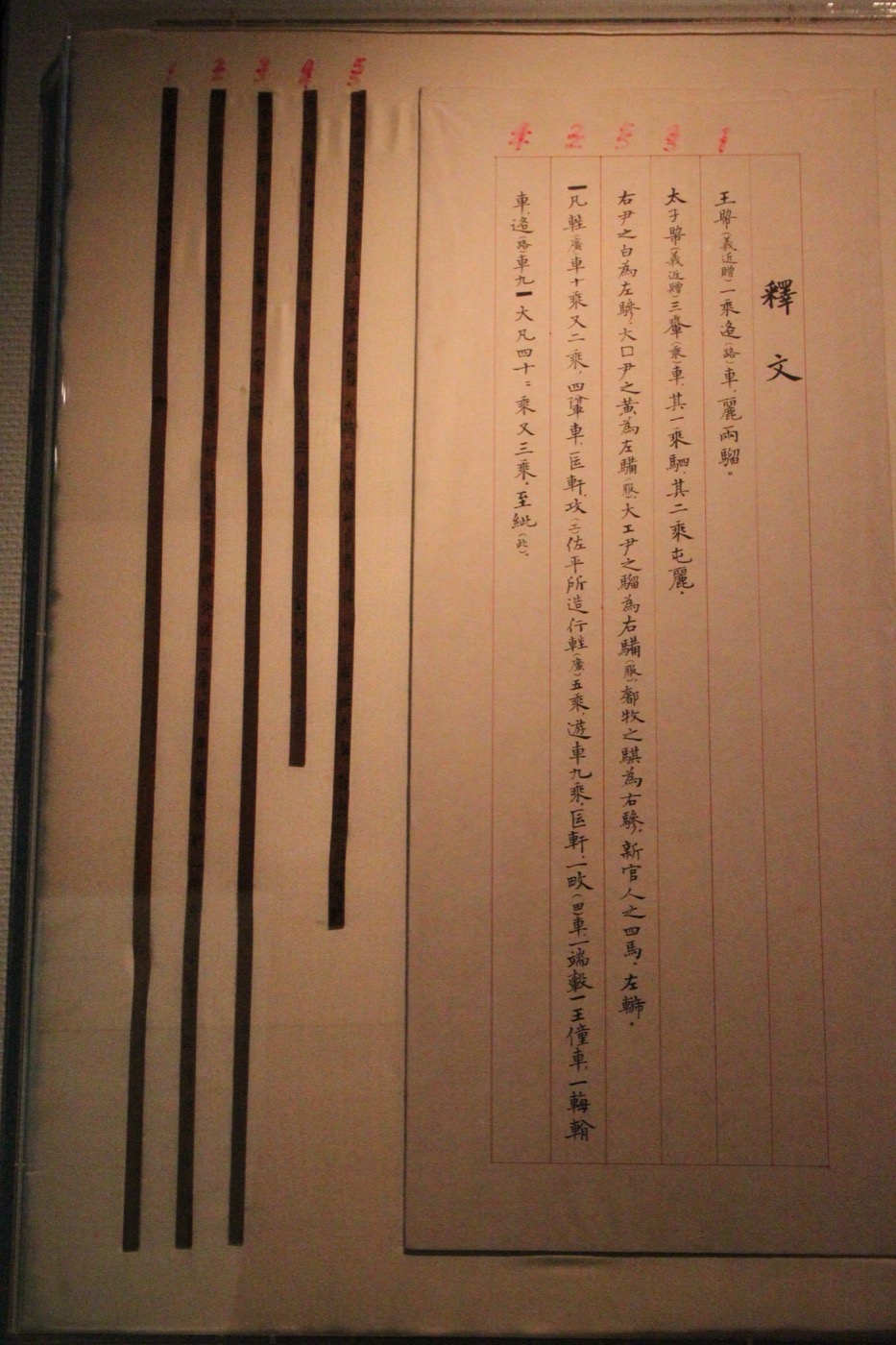 Brushstrokes frozen in time: Ancient bamboo slips excavated across Hubei on exhibition at the Provincial Museum. Oxygen-free groundwater and dense clay sealed the ink for over two millennia. (Source: Wikimedia Commons, CC BY-SA 2.0)
The brothers go on to ask whether their cousin has safely brought home the soldier’s pay, inquire whether their newlywed wives are getting along with the family elders, and urge their younger sister not to neglect the household chores.
Dynastic histories like Sima Qian’s Records of the Grand Historian remember Qin as an unstoppable war machine of iron armor and ruthless legalist discipline. But down in the silt of the vanished marsh, what survived was not a bronze monument to the First Emperor. It was a shivering boy at a river garrison, worried that his summer uniform wouldn’t arrive before the heat set in, asking his mother if she was sleeping well.
4. Li Bai’s Drunken Decade on Mount Baizhao
Leave Yunmeng and drive thirty minutes north across the gentle rolling hills, and you enter Anlu (安陆).
If Yunmeng belongs to the anonymous workers who kept the imperial machine spinning, Anlu belongs to China’s most celebrated romantic rebel: Li Bai (李白).
Most foreign travelers know the standard Li Bai iconography: balancing a wine goblet under the moon in Chang’an, drifting through the steep cliffs of the Three Gorges, or leaping into water after an elusive reflection. But very few realize that in 727 CE, when the 27-year-old poet left Sichuan and drifted down the Yangtze into central China, he didn’t head straight for the capital.
He stopped in Anlu, fell in love, and stayed for ten entire years (727–737 CE).
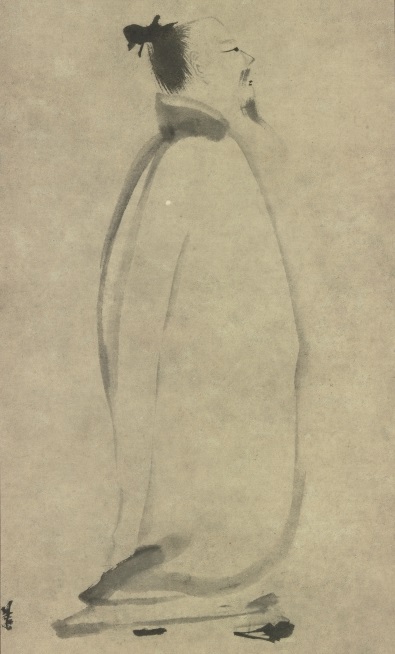 Li Bo in Stroll (李白行吟图) by Southern Song master Liang Kai. Between ages 27 and 37, Li Bai made Anlu his rural sanctuary, brewing spring wine and writing job petitions invoking the wild marshland. (Source: Tokyo National Museum / Wikimedia Commons, Public Domain)
In Anlu, Li Bai married Lady Xu, the educated granddaughter of Xu Yushi (许圉师), a former Tang dynasty chancellor. Settling in a thatched villa at the foot of Mount Baizhao (白兆山), the ambitious young poet lived a life of deliberate duality.
On one hand, it was a decade of domestic hermitage: wandering among pine ridges, brewing wine with mountain spring water at Ganzhu Spring, and writing playful verses to local monks. Later in life, looking back on this period with mixed pride and rueful nostalgia, he wrote the famous line:
“酒隐安陆,蹉跎十年。”
“Dwelling in wine and hermitage at Anlu, ten wandering years slipped away.”
On the other hand, Li Bai was tirelessly ambitious. From his mountain desk, he penned elaborate self-recommendation petitions (shangshu) to provincial governors across central China, angling for an imperial court appointment without having to sit for the rigid imperial civil service examinations. In these letters, he repeatedly invoked the vast, untamed phantom water of Yunmengze as a symbol of his own boundless talent—telling magistrates that like the legendary ancient marsh, his mind contained whole continents of wind and water that the small confines of a county office could never hope to hold.
Late November Bonus: The Golden Ginkgo Valley of Qianchong
If your itinerary falls between mid-November and early December, an essential seasonal detour lies thirty kilometers southwest of Anlu: the Qianchong Ancient Ginkgo Valley (钱冲古银杏生态旅游区).
(What is a ginkgo? The ginkgo, or 银杏 yínxìng, is a prehistoric botanical “living fossil”—the only surviving species of an order of trees that flourished over 200 million years ago, before dinosaurs even walked the earth. In late autumn, its distinctive fan-shaped green leaves undergo a synchronized chemical alchemy, turning an incandescent, luminous golden yellow that carpets the mountain floor in pure amber).
While tourists jostle for elbow room in Beijing’s Diaoyutai or Kyoto’s temple gardens, Qianchong is home to over 4,600 ancient ginkgo trees with trunks that take three adults to embrace, including dozens of specimens that have stood for more than a thousand years.
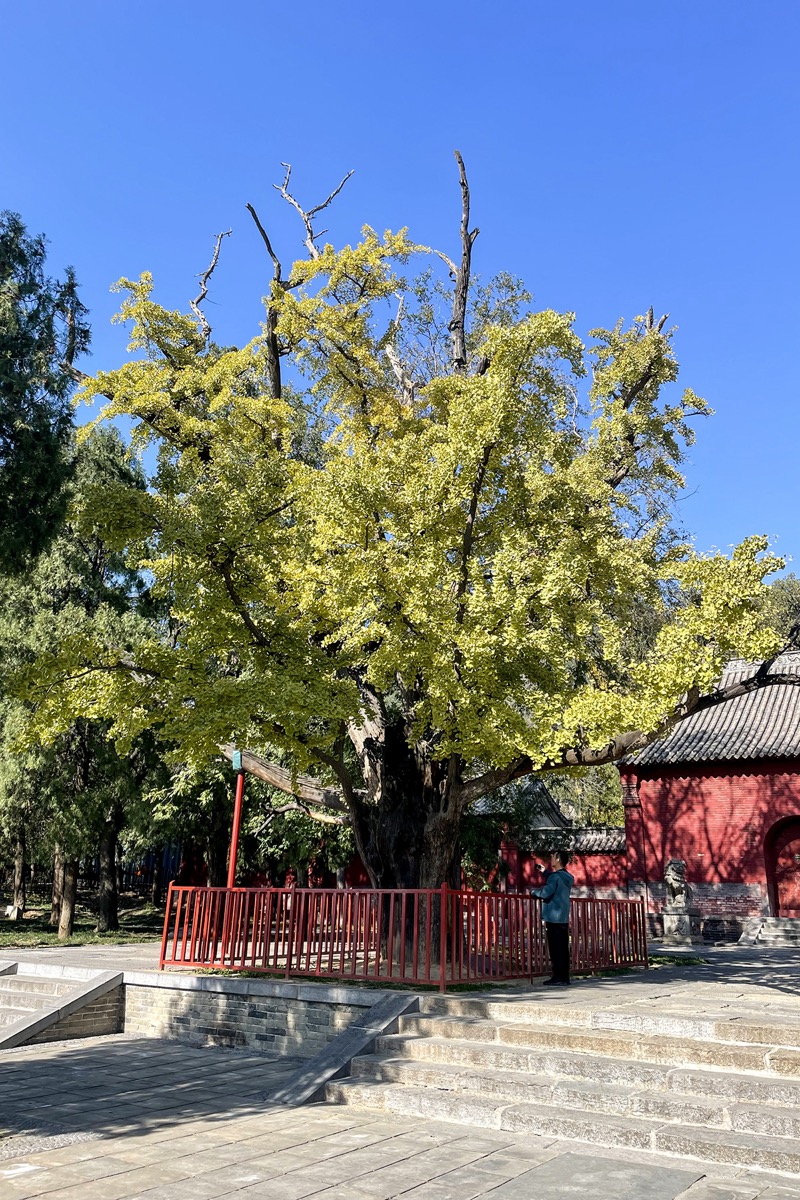 Golden canopy: Ancient ginkgoes in late autumn. In Anlu’s Qianchong Valley, thousands of millennial ginkgo trees turn mountainsides into living scrolls of gold from mid-November to early December. (Source: Wikimedia Commons, CC BY-SA 4.0)
When the autumn chill rolls down from the Dabie Mountains, the narrow mountain roads through Qianchong wind through whole canyons of incandescent yellow and amber scarlet. Fallen leaves blanket farmyard stone courtyards in deep gold, looking less like a curated tourist attraction and more like a live Song dynasty scroll painted in mineral pigments.
5. The ChinaStay Field Guide: Visiting Anlu & Yunmeng
Because both towns are tucked into the Greater Wuhan Metropolitan Circle, this itinerary makes one of the most rewarding, off-the-beaten-track cultural day excursions (or weekend escapes) in central China. You will encounter almost zero international tour groups, low domestic crowd density, and an authentic taste of small-town Hubei hospitality.
Board morning bullet train from Hankou Station (C/D series, from ¥18.5).
Inspect genuine Shuihudi slips, Yueren’s calendar, and forensic 3D head of Clerk Xi.
12-minute train to Anlu West; hike Li Bai’s hermitage, Peach Blossom Crag, and springs.
Hire a local car to see 4,600+ millennial ginkgo trees blanket valleys in pure gold.
High-Speed Rail Connections
Getting here could not be simpler thanks to the modern high-speed train network:
- Wuhan (Hankou Station) ➔ Yunmeng East: The fastest intercity trains take just 24 minutes. Second-class seats start at roughly ¥18.5.
- Wuhan (Hankou Station) ➔ Anlu West: Fast trains take approximately 39 minutes (around ¥29).
- Between Yunmeng East & Anlu West: High-speed trains run between the two neighboring stops in just 12 minutes for about ¥11.
ChinaStay Tip: Search and book your tickets through the official China Railway 12306 English app using any international passport and foreign card, or cross-check schedules via Trip.com.
Stop 1: Yunmeng County Museum (云梦祥山博物馆)
Do not let the word “county” fool you. Yunmeng County Museum is frequently cited by Chinese historians as one of the finest county-level museums in the entire country.
- The Highlights: The second-floor paleography gallery displays genuine excavated bamboo slips from the Shuihudi Qin tomb and Clerk Yueren’s M77 tomb, along with high-resolution digital microscopes that allow you to inspect 2,200-year-old ink brushstrokes. You can also view the life-sized forensic 3D facial reconstruction of Clerk Xi (喜), based on his excavated skull.
- Admission: Free.
- Booking & Entry: Foreign visitors can either show an original physical passport directly at the visitor reception desk for on-site registration, or make an advance reservation via the official WeChat Mini Program
云梦文旅(search “云梦祥山博物馆” inside WeChat). - Time Needed: 2 to 2.5 hours.
Stop 2: Mount Baizhao Li Bai Cultural Tourism Area (白兆山李白文化旅游区)
Located in Yandian Town (烟店镇) just northwest of Anlu city center, Mount Baizhao is a peaceful, heavily forested hill with gentle stone pathways:
- What to See: Walk through Taibai Peak (太白峰), Peach Blossom Crag (桃花岩), the replica hermit study of Li Bai, and Ganzhu Spring (绀珠泉), where clear hillside water still bubbles up through stone basins.
- Tickets: Approximately ¥49–¥60 per adult at the main gate. (Note: The scenic mountain park entrance is separate from the municipal Li Bai Memorial Hall located in downtown Anlu).
- Time Needed: Half a day (2 to 3 hours of leisurely walking).
Stop 3: Qianchong Ancient Ginkgo Valley (Seasonal)
If you visit between November 15 and December 5, hire a local driver from Anlu for an afternoon trip out to Qianchong.
- Dress Code: Mountain valleys in Hubei get brisk once the afternoon sun dips below the ridges. Bring a good windbreaker or woolen layer.
- Local Snacks: Try fresh roasted ginkgo nuts (银杏果), sweet lotus root soup (paigu lian’ou tang), and dried persimmons sold by village grandmothers outside their stone houses.
Practical Survival Advice for Foreign Visitors
Because Anlu and Yunmeng are genuine small inland county seats rather than international tourist destinations like Shanghai or Beijing, a few practical preparation steps will make your trip effortless:
- Cashless Payments: Even the smallest fruit vendor and roadside noodle stall in Yunmeng will expect mobile QR codes. Make sure you set up Alipay and WeChat Pay with your foreign credit card before boarding the train in Wuhan.
- Ride-Hailing & Navigation: Hailing a metered street taxi at Yunmeng East or Anlu West railway stations can occasionally involve language friction. Use the Didi Mini Program embedded inside Alipay to book rides; your pickup point and destination are pinned in English on the screen, and payments settle automatically.
- Digital Maps & Offsets: Due to China’s national GCJ-02 geodetic datum offset, foreign Google Maps often misplaces satellite markers by hundreds of meters. Use Apple Maps (which automatically uses AutoNavi’s verified Chinese vectors on iOS) or have an translation app ready for Amap (高德地图). Make sure your mobile data is sorted via an eSIM or clean roaming connection.
- Transit Policies: If you are arriving through Wuhan Tianhe International Airport (WUH), remember that Hubei falls under China’s 30-day unilateral visa exemption and 240-hour visa-free transit rules. You can check your passport eligibility on our Interactive Visa-Free Checker.
- Connecting This Route: This 1-to-2 day excursion pairs brilliantly with a wider regional journey. Combine it with the architectural lofts of Jingdezhen, the historic alleys of Hangzhou, or follow our comprehensive One-Month China Slow Travel Itinerary.
- Wuhan Breakfast Fuel: Passing through Wuhan at dawn before catching your train north to Yunmeng? Grab hot pan-fried Sanxian Doupi at a neighborhood guozao stall — or practice flipping the crispy mung-bean crust in our free mini-game Street Food Legends: Wuhan Doupi.
Plan a Custom Literary Tour in Hubei
Want a private licensed driver to take you straight from Wuhan Tianhe Airport to the ancient ginkgo groves of Qianchong, or need a bilingual historian guide to walk you through the Shuihudi bamboo slips at Yunmeng Museum?
Our bespoke travel architect Lucy Liu coordinates private itineraries, museum permissions, and vetted car services across Hubei and beyond. Explore our Tailored Travel Planning Service or get in touch directly at hello@chinastay.org.
Curator of China Nomad Guide. Specializing in bespoke route architecture, bilingual on-the-ground fixer services, and neutral medical/dental tourism logistics. Based between Chengdu, Yunnan, and Shanghai.
Get the China Stay China Arrival Kit & Checklist
Don’t get locked out without connectivity or payment at the border. Instant access to our interactive 12-step field guide + offline 1-page PDF printable cheat sheet covering pre-flight eSIMs, foreign card Alipay binding, PSB police registration, and railway ticketing.
Curated by Villanelle (IG: @v.forvillanelle • hello@chinastay.org). Zero spam.