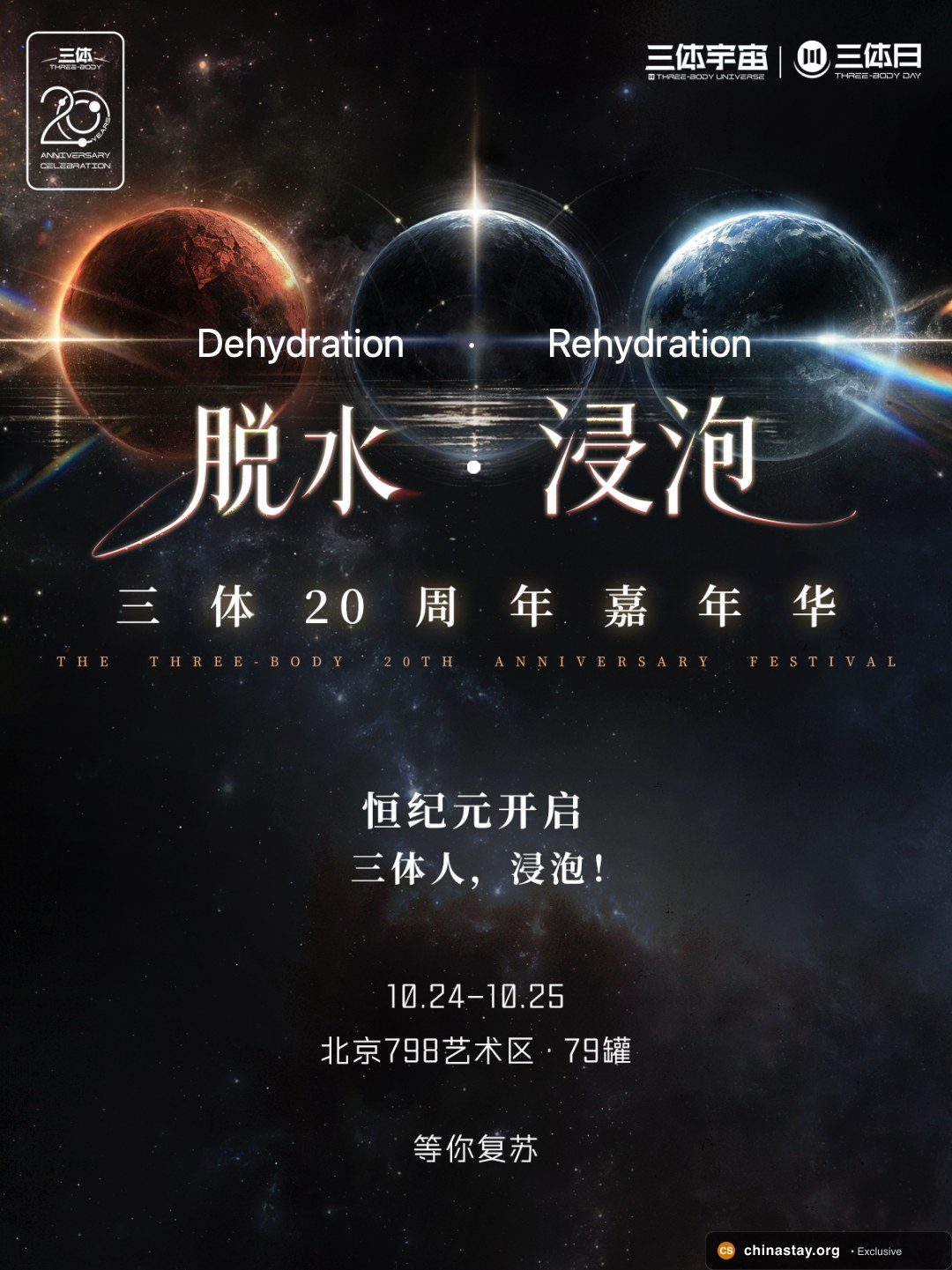
[!NOTE] AN EXCLUSIVE DISPATCH FROM BEIJING (OCTOBER 24, 2026) Every year around October 21–24, Chinese sci-fi fandom congregates for Three-Body Day (三体日). This year marked the landmark 20th Anniversary of the original serialization of Liu Cixin’s Hugo Award-winning masterpiece The Three-Body Problem (三体). Below is our exclusive, on-the-ground report from inside Tank 79 (79罐) in Beijing’s 798 Art District—featuring live on-stage revelations from Cixin Liu and legendary auteur Zhang Yimou.
Key Takeaways (TL;DR)
- The Feature Film Is Real: On October 24, 2026, Zhang Yimou (张艺谋)—the visionary auteur behind Hero, Raise the Red Lantern, and the transcendent 2008 Beijing Olympics Opening Ceremony—appeared live on stage with Cixin Liu to confirm he is helming the brand-new cinematic adaptation of The Three-Body Problem.
- Production Status & Release Window: Jointly produced by Enlight Media (光线传媒) and The Three-Body Universe (三体宇宙), the movie is currently in deep screenplay polishing and pre-production, aiming for a grand theatrical premiere around 2028.
- The Live Stage Moment: Cixin Liu personally autographed a collector’s edition copy of the trilogy on stage and presented it to Zhang, who addressed the crowd stating he feels “deeply honored and humbled to shoulder the cinematic burden of this universe.”
- Director Yang Lei on Stage: Yang Lei, the director who masterminded the acclaimed 30-episode book-faithful Tencent television series, also joined the creator panels at Tank 79 alongside visual director Lu Beike.
- The Fandom Screening Mechanism: Getting into Three-Body Day requires reserving slots a week in advance and taking an ideological entrance quiz dividing entrants into PDC (Planetary Defense Council) or ETO (Earth-Trisolaris Organization).
1. Entering Tank 79: The Ideological Quiz and the Three-Sun Dome
If you have ever visited Beijing’s 798 Art District, you know its stark industrial bones: soaring Bauhaus-designed electronics workshops built with East German engineering in the 1950s, weathered brick chimneys, and cavernous circular fuel-gas silos.
For the 20th Anniversary Three-Body Carnival (脱水 · 浸泡 / Dehydrate · Rehydrate), the organizers took over Tank 79 (79罐)—a colossal circular iron cylinder that looks like it was plucked straight out of the Crisis Era space fleet docks.
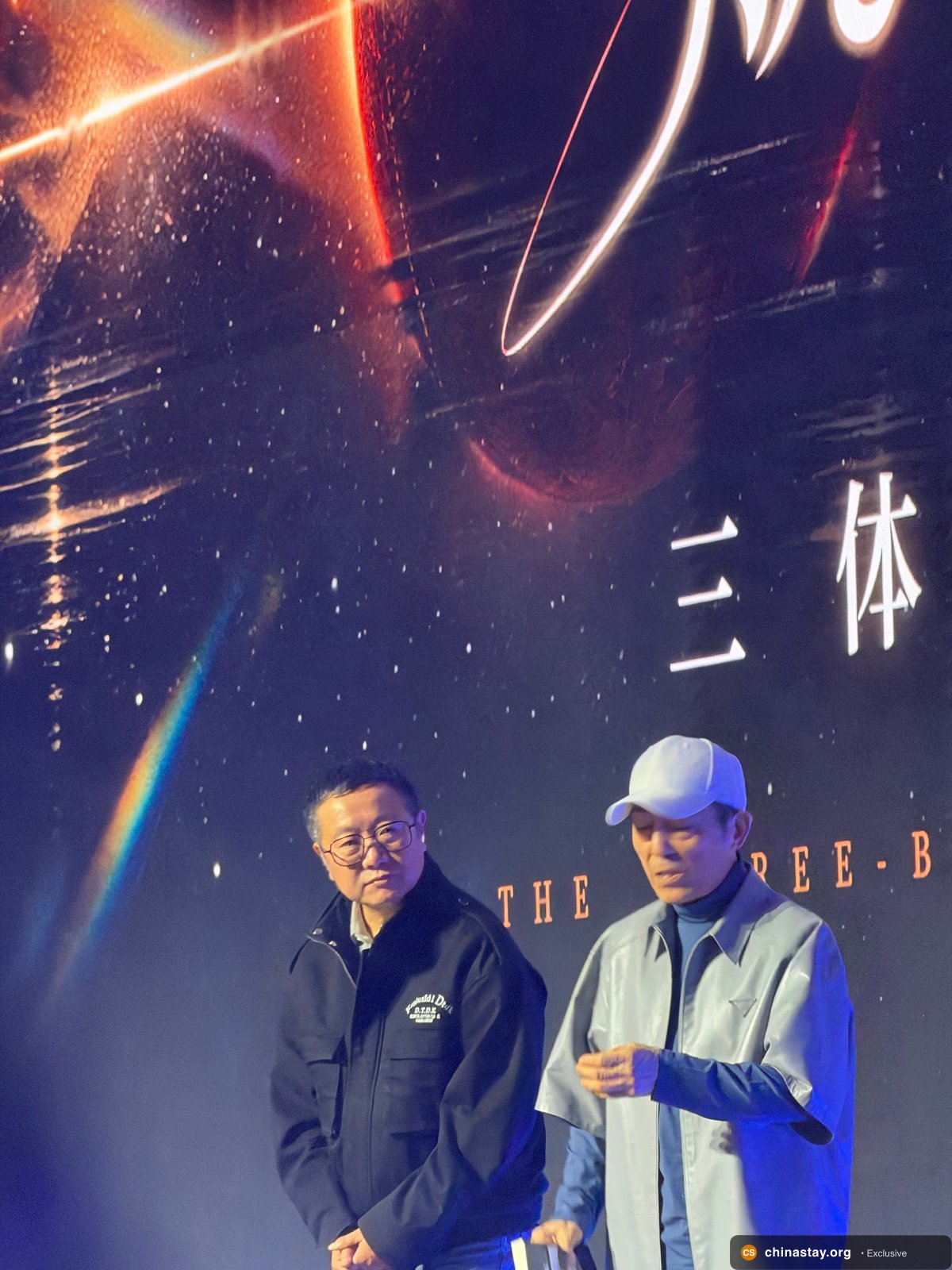 Exclusive photo from Three-Body Day at Tank 79, Beijing: Author Cixin Liu (left) with legendary filmmaker Zhang Yimou (right) discussing the upcoming 2028 feature film.
The PDC vs. ETO Moral Triage
Attending Three-Body Day is not a simple walk-in affair. Because capacity inside Tank 79 is strictly regulated, ticket reservation opened exactly one week prior through a dedicated WeChat mini-program.
Before you could confirm your booking slot, the system forced you through an interactive philosophical questionnaire:
- Do you believe humanity can resolve its ecological and moral decay independently?
- If a super-civilization offered to cleanse human corruption, would you transmit your coordinates?
- How do you view Ye Wenjie’s choice atop Radar Peak in 1971?
Your answers determine whether your electronic admission badge brands you as PDC (Planetary Defense Council / 行星防御理事会) or ETO (Earth-Trisolaris Organization / 地球三体组织).
I must confess: spiritually and philosophically, I harbor deep, quiet empathy for Ye Wenjie. Looking at geopolitics, climate crises, and rampant short-termism, it is frighteningly easy to slip into adventist fatalism. But faced with an algorithmic quiz that might determine my event security tier, I swallowed my cynicism, answered like a textbook human loyalist, and got stamped as a proud member of the PDC.
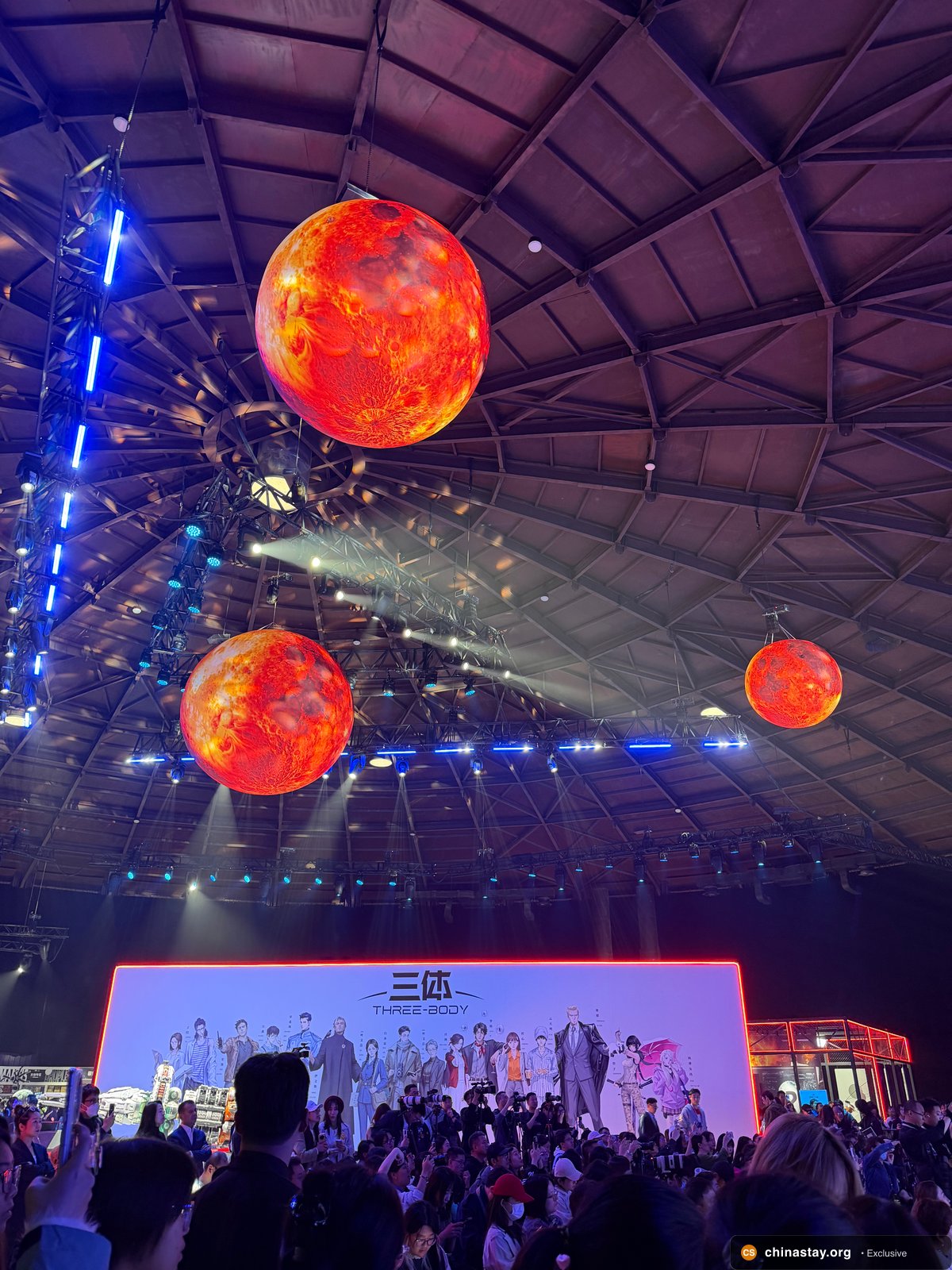 Inside Tank 79: Three incandescent artificial suns suspended from the dome rafters, simulating the chaotic three-sun syzygy (三日凌空).
Once inside our designated time block, we queued up at the entry checkpoint to collect physical Task Cards (任务卡) and an illustrated Survival Field Guide (游玩指南).
Stepping into the main chamber took my breath away. Suspended 30 meters above the floor from the silo’s geodesic iron dome were three colossal, glowing red suns—a physical recreation of the Trisolaran system’s nightmare orbital syzygy (三日凌空). Bathed in crimson light, thousands of fans walked between holographic exhibits, military war rooms, and art installations.
2. The Main Event: Cixin Liu, Zhang Yimou, and the 2028 Feature Film
The defining highlight of the day took place on the central stage. Getting into the auditorium and securing access to the autograph hall required a second, fiercely contested reservation.
When the stage lights dimmed and the cosmic synth soundtrack swelled, Cixin Liu (刘慈欣) stepped onto the stage. Dressed in his quintessential black work jacket, frameless glasses, and modest posture, “Da Liu” looked less like a world-famous sci-fi titan and more like the pragmatic thermal power-plant computer engineer he spent decades being in Shanxi.
Then came the earthquake: walking out to join him was Zhang Yimou (张艺谋), wearing his signature white baseball cap, a grey tech-fabric work vest, and an unassuming smile.
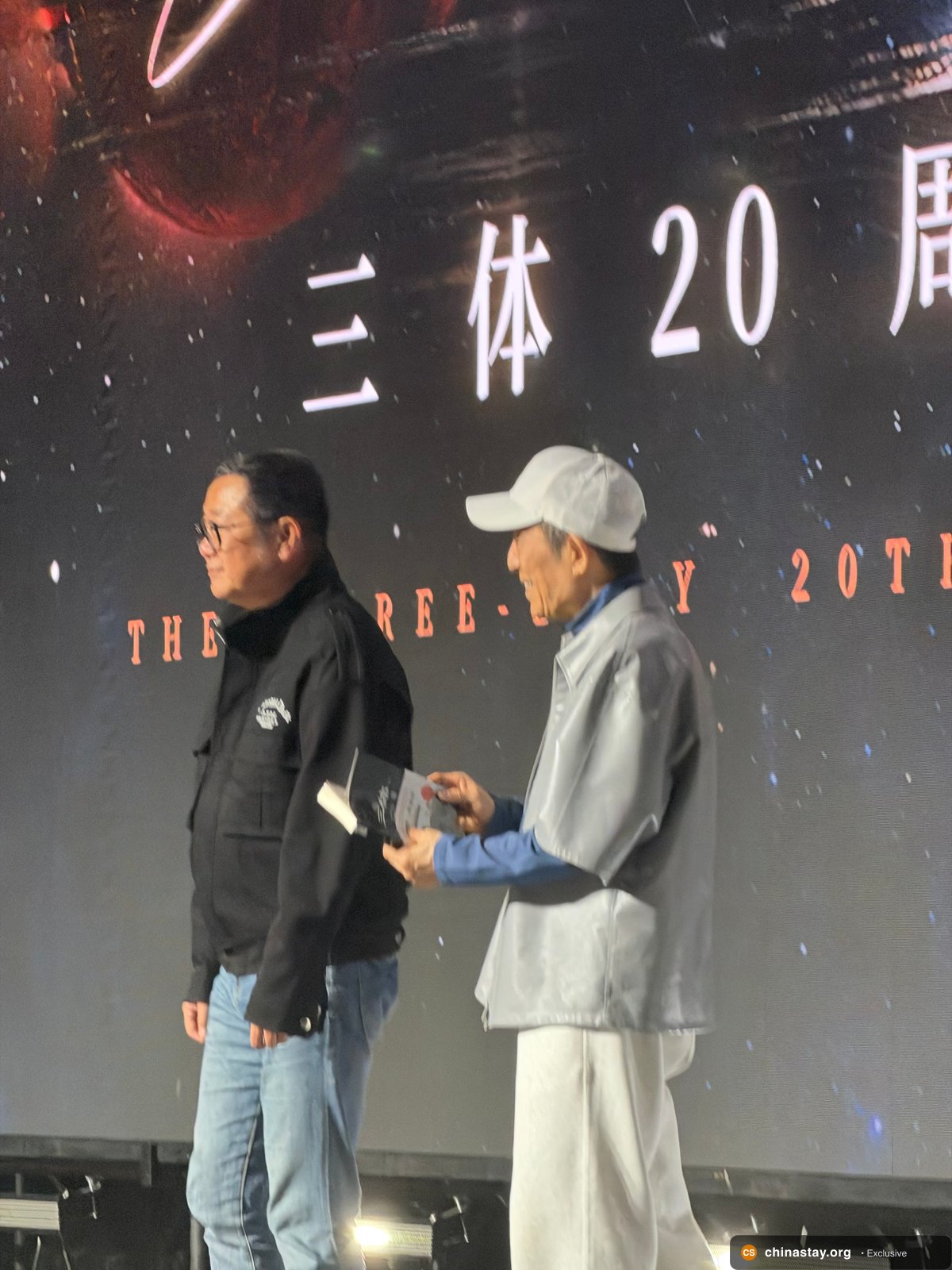 Zhang Yimou (right) admiring the autographed collector’s edition of The Three-Body Problem just signed on stage by Cixin Liu (left).
The Official Announcement
For years, rumors of a Chinese cinematic Three-Body adaptation have lingered in development purgatory. Early attempts in 2015 were shelved due to poor visual effects and fragmented scripts.
On stage at Tank 79, the official reality was laid bare:
- Director: Zhang Yimou has formally signed on to direct the live-action theatrical film.
- Producers: Jointly bankrolled and developed by Enlight Media (光线传媒)—the production powerhouse behind China’s top animated and cinematic blockbusters—and The Three-Body Universe (三体宇宙).
- Timeline: The production is currently undergoing rigorous screenplay polishing and visual world-building, targeting an anticipated theatrical release around 2028.
- The Stage Ceremony: Before hundreds of camera flashes, Cixin Liu took a pen, autographed a hardcover copy of the book, and handed it directly to Zhang. Zhang smiled broadly, bowing slightly, and told the audience how deeply honored he felt to take on the most ambitious cinematic canvas of his lifetime.
Why Zhang Yimou Directing Changes the Stakes
For Reddit’s r/threebodyproblem and Western readers, the reaction to Zhang Yimou directing might spark curious questions: Isn’t Zhang an art-house director? Can an 75-year-old maestro handle hard sci-fi quantum physics and relativistic space battles?
To understand why Chinese fans are ecstatic, you have to look at what Zhang Yimou actually represents in visual history:
- Master of Monumental Scale: Zhang orchestrated the 2008 Beijing Olympics Opening Ceremony—arguably the greatest live visual spectacle in modern human history. He understands how to maneuver vast crowds, create hypnotic geometric symmetries, and convey the sheer grandeur of an entire civilization moving in unison.
- Mastery of Eastern Visual Philosophy: Films like Hero (英雄) and Raise the Red Lantern (大红灯笼高高挂) proved that nobody understands color theory, spatial composition, and dramatic silence better than Zhang. In The Three-Body Problem, the horror is rarely loud; it is the silent, cold dread of the universe—the quiet ticking of a cosmic countdown, the mirror finish of the Droplet, the flattening of a solar system into two dimensions.
- The Gritty Historical Anchor: The entire emotional foundation of The Three-Body Problem hinges on Ye Wenjie’s trauma during the Chinese Cultural Revolution. Having lived through that exact era himself, Zhang Yimou has directed the definitive cinematic explorations of that period (such as To Live / 活着). He possesses the exact historical marrow needed to ground Ye Wenjie’s disillusionment with reality.
3. An Editor’s Perspective: Chinese Fandom vs. the Netflix Adaptation
(Editor’s note: While the stage conversation focused strictly on the upcoming Chinese production, the contrasts between Eastern and Western adaptations were the dominant topic of whispered debates among the fans browsing the convention floor.)
When Netflix released its 8-episode adaptation created by David Benioff, D.B. Weiss, and Alexander Woo in 2024, the reaction in China was complex and intensely debated.
| Creative Dimension | Tencent TV Series (30 Episodes, 2023) | Netflix Adaptation (Season 1, 2024) | Expected Zhang Yimou Film (2028) |
|---|---|---|---|
| Director / Showrunner | Yang Lei (杨磊) | Benioff & Weiss (Game of Thrones) | Zhang Yimou (张艺谋) |
| Fidelity to Original Book | ~95% word-for-word book accuracy | Heavy remix; compressed “Oxford Five” | Cinematic distillation of core philosophical themes |
| Cultural Revolution Prologue | Muted/rearranged due to domestic broadcast broadcast rules | Visceral, explicit, and accurate to English book opening | Deep, cinematic, period-accurate psychological depth |
| Pacing & Atmosphere | Deliberate, clinical, procedural hard sci-fi mystery | Rapid-fire Western prestige drama thriller | Monumental, poetic, epic visual storytelling |
| The “Judgment Day” Canal Scene | Clinical, methodical, tension built over episodes | High-octane Hollywood horror and rapid cutting | High anticipation for grand spatial composition |
Among Chinese book purists, the consensus remains clear:
- What Netflix Got Right: Chinese fans universally lauded the visual fidelity of the Panama Canal nano-filament sequence (“Operation Guzheng”) and the sheer spectacle of the Trisolaran dehydrated army peeling across the desert sky.
- What Netflix Sacrificed: Condensing complex Chinese protagonists (Wang Miao, Ding Yi, Luo Ji, Cheng Xin, Yun Tianming) into a tightly knit clique of young British friends made the global existential threat feel uncomfortably small—like a localized campus melodrama. Crucially, it excised the heavy intellectual fatalism, bureaucratic realism, and quiet existential dread that define Chinese hard sci-fi.
This is why having Yang Lei (杨磊) on stage at Tank 79 alongside visual director Lu Beike (陆贝珂) felt so grounding.
 Stage panel at Tank 79: Tencent 3-Body TV series director Yang Lei (center) and visual director Lu Beike (right) discussing adapting complex literary sci-fi.
Yang Lei’s 30-episode series proved that audiences do have the patience for 45-minute conversations about cosmic background radiation, cosmic sociological axioms, and scientific despair. With Yang Lei holding down television and Zhang Yimou commanding cinema, fans feel the intellectual integrity of the universe is in the safest hands imaginable.
4. Inside the Lore: Red Coast Base, Sophon Terminals, and Yun Tianming’s Brain
Beyond the stage announcements, the floor of Tank 79 was a meticulously curated museum of literary artifacts.
Ye Wenjie’s Desk at Red Coast Base (红岸基地)
Tucked away in the eastern quarter of the silo was a full-scale tactile replica of the 1970s transmission control bunker at Red Coast Base atop Radar Peak.
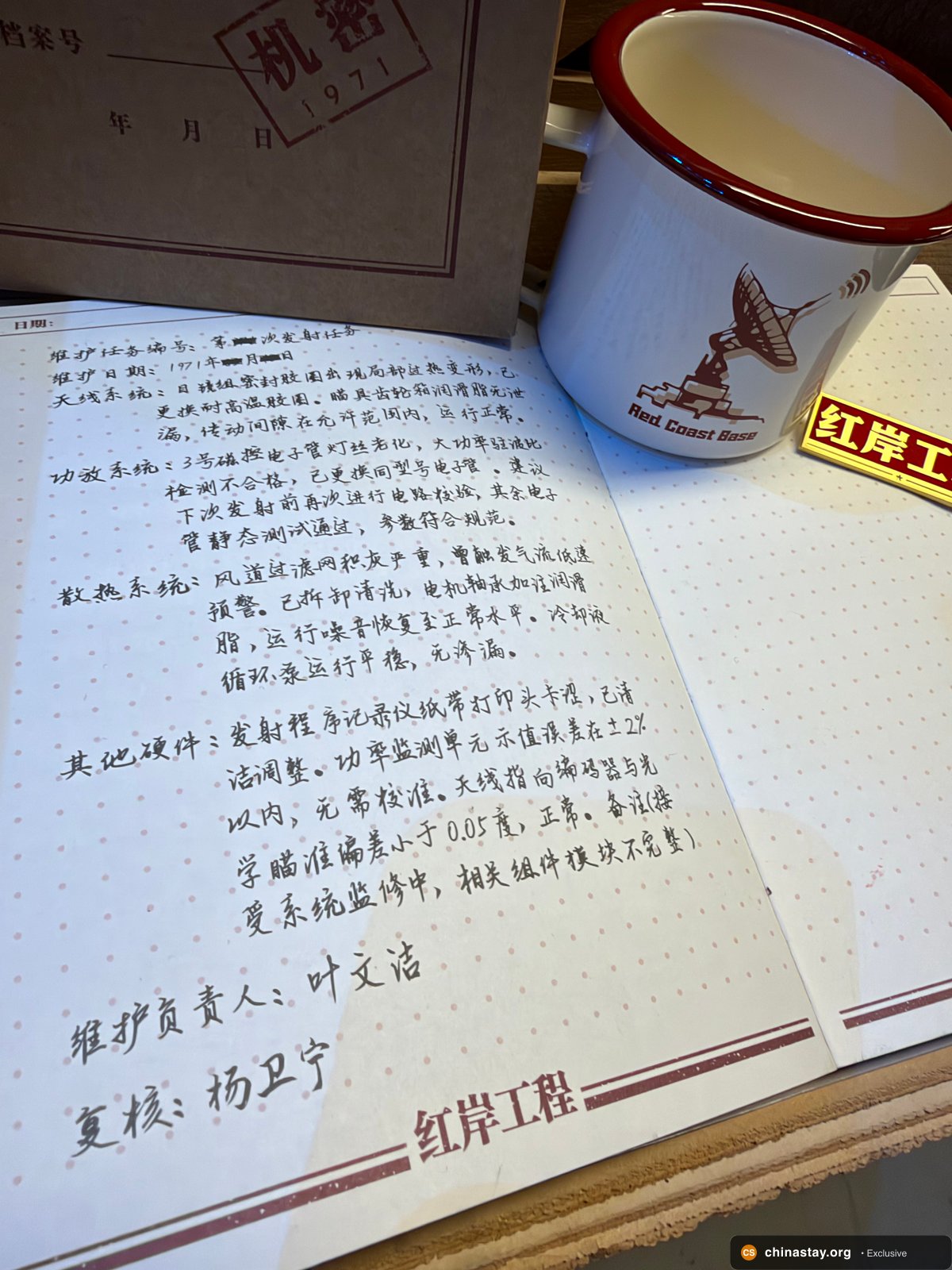 Tactile historical replica: The classified 1971 Red Coast Base transmission logbook, maintenance notes signed by Ye Wenjie (叶文洁), and retro enamel mug.
Resting on the wooden desk was a vintage enamel tea mug painted with the Red Coast satellite dish, retro logarithmic slide rules, and an open, yellowed maintenance notebook.
Bending down to examine the calligraphy, the logbook read:
Maintenance Task Number: 1971 System Alignment
Antenna System: Minor overheating observed in vacuum seals. Cleared and re-lubricated with high-temperature compound…
Maintenance Lead: 叶文洁 (Ye Wenjie)
Reviewed by: 杨卫宁 (Yang Weining)
Touching the rough paper of that logbook—the exact document where Ye Wenjie secretly pointed the 25-megawatt beam toward the sun and sealed the fate of human civilization—gave every reader in the room chills.
Sophon’s Interactive Chatbot & The Beeper Power Bank
Nearby stood the Sophon Monitoring Room (智子监控终端). Organizers had hooked up a large-language model custom-trained on the novels’ dialogue to an interactive terminal. Fans lined up to type existential questions directly to Trisolaris:
- User: “Are you afraid of humanity?”
- Sophon Screen: “AI is not an accurate categorization. Sophon is an intelligent proton manifold… Destruction requires no malice; it only requires an obstacle. You ask this question because you project the human emotional concept of ‘spite’ onto physics.”
At the merchandise boutique, fan humor shone through with spectacular absurdity. Beside pins stamped with the red seal of Red Coast Base sat retro Beeper Power Banks with glowing LCD screens cycling through the three terrifying characters:
不要回答!不要回答!不要回答!
(Do not answer! Do not answer! Do not answer!)
And hanging proudly in the center display case was the undisputed crowd favorite: Yun Tianming’s Brain Plush Pendant—a soft pink embroidered brain encased in a transparent vacuum container on a key ring, commemorating humanity’s tragic Staircase Project (阶梯计划).
 Dark humor at its finest: Official plush pendant of Yun Tianming’s brain preserved in a cryo-jar from the Staircase Project.
5. Practical Traveler’s Guide: How to Experience China’s Sci-Fi Scene
If you are a foreign sci-fi fan traveling to China or planning a trip around future Three-Body Day gatherings, here is everything you need to know.
1. Attending Three-Body Day (Annual October Event)
- When: Every year between October 20 and October 25 (aligned with the novel’s serial launch anniversary).
- Where: Typically hosted in Beijing (often Tank 79 / 798 Art District) or Shanghai.
- Ticketing & Foreign Passports: Bookings run through the official Three-Body Universe (三体宇宙) WeChat mini-program. Foreign travelers can register using their physical passport number. Because slots fill up within minutes of opening, set alarms exactly 7 days prior.
- Bilingual Access: Major panels and visual exhibits feature bilingual English/Chinese signage. The community is remarkably welcoming to international fans—many bilingual local readers are eager to debate cosmic sociology with visiting foreigners.
2. Exploring Beijing 798 Art District (Chaoyang)
- Getting There: Take Beijing Subway Line 14 to Wangjing South (望京南) or Jiangtai (将台) Station, followed by a short 5-minute taxi or 15-minute walk.
- Why 798 Matters: Beyond Three-Body Day, 798 is China’s premier contemporary art hub. The raw Bauhaus architecture, decommissioned industrial steam pipes, and cyberpunk installations make it feel like a living set piece from the Crisis Era.
3. The Ultimate Chinese Sci-Fi Pilgrimage Route
If you have two weeks in China on your 240-Hour Visa-Free Transit or tourist visa, consider this epic literary circuit:
- Beijing: Visit 798 Art District and the Planetarium in Xicheng District where early Chinese astronomy met modern cosmology.
- Chengdu (Sichuan): The historic capital of Chinese science fiction. Visit the Chengdu Science Fiction Museum in Pidu District (host of the 81st WorldCon in 2023), home to Science Fiction World (科幻世界) magazine where The Three-Body Problem was first published.
- Pingtang, Guizhou: Visit FAST (Five-hundred-meter Aperture Spherical radio Telescope / 中国天眼)—the world’s largest single-dish radio telescope nestled in the lush karst mountains. Standing on the rim of that colossal silver dish is the closest you will ever get on Earth to standing atop Radar Peak.
Final Thoughts: The Universe Is Grand, and Life Is Grander
Leaving Tank 79 into the cool Beijing autumn night, I walked past the giant graffiti wall where hundreds of fans had left handwritten notes under the banner “I Am Speaking to Trisolaris.”
One note pinned near the center read simply:
“给岁月以文明,而不是给文明以岁月。”
(Give civilization to years, not years to civilization.)
Watching Cixin Liu and Zhang Yimou stand together on that stage was a reminder of how far this story has traveled. Twenty years ago, it was a serialized story scribbled by an engineer during night shifts in a dusty power plant in Shanxi. Today, it is an undeniable global cultural touchstone—and in the visual hands of Zhang Yimou, the journey of human civilization toward the stars has only just begun.
Curator of China Nomad Guide. Specializing in bespoke route architecture, bilingual on-the-ground fixer services, and neutral medical/dental tourism logistics. Based between Chengdu, Yunnan, and Shanghai.
Get the China Stay China Arrival Kit & Checklist
Don’t get locked out without connectivity or payment at the border. Instant access to our interactive 12-step field guide + offline 1-page PDF printable cheat sheet covering pre-flight eSIMs, foreign card Alipay binding, PSB police registration, and railway ticketing.
Curated by Villanelle (IG: @v.forvillanelle • hello@chinastay.org). Zero spam.